
Japanese Arita Porcelain
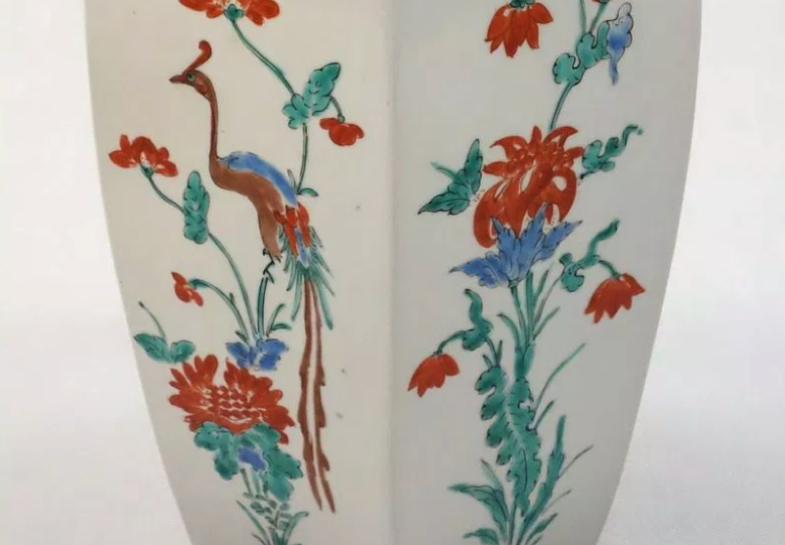
Hello! After a break from the blog, I am returning with this post about Arita porcelain.
I hope you enjoy it! :)
Introduction
Arita porcelain comprises wares fired around the town of Arita, in Nishimatsuura District, Saga Prefecture, in Japan’s Kyūshū region. Because these wares were exported through the port of Imari, they were also known as Imari ware.
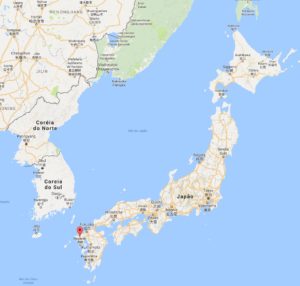
The Arita region in Japan. Source: Google Maps
The region developed as a porcelain-making centre after a Korean potter arrived in the 1610s and discovered porcelain clay in the local Izumi mountain. It was the first region to produce porcelain in Japan. Initially, potters used some-tsuke (blue designs on a white ground), taking Chinese Jingdezhen porcelain as their model.
The Development of Arita Ware
As Imari ware was developing, China’s Qing dynasty imposed a maritime blockade to cut off the revenue of former subjects loyal to the deposed Ming dynasty. From 1640, Western countries consequently found it difficult to import Chinese ceramics. The Dutch, who were permitted to trade with Japan, turned their attention to Imari porcelain. At first, these pieces were taken to Europe as Chinese products. Their successful reception gave the makers confidence to develop other techniques, including nigoshi-de clay, which gave the porcelain a distinctive milky-white ground.
From 1640, they also began working with iro-e, coloured designs painted over porcelain. In China, iro-e is called Wucai (five colours), a technique involving painting fired pieces with coloured enamels and firing them again at lower temperatures.
During this period, the celebrated Kakiemon style also emerged for export, exerting considerable influence throughout Europe.
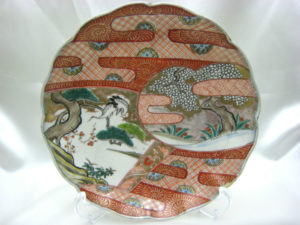
A Kakiemon-style plate
Because Western buyers favoured iro-e porcelain, efforts focused on improving this technique. During the Genroku era (1688–1704), a technique known as Kinrande was added. Literally meaning “gold brocade” (金襴手), it often distinguished this porcelain through gold decoration. The work was elaborate, but division of labour and the use of stepped kilns with adjoining chambers (renboshiki-kaidanjō noborigama) allowed makers to meet the high demand despite the substantial increase in work required for each piece. The Kinrande style, with its splendid designs, was also highly appreciated by the wealthier sections of Japan’s merchant class. The height of Imari ware coincided with the emergence of the magnificent culture of Genroku (Genroku bunka).
Although production served both domestic and foreign markets, the products differed. Generally, the “Kata-mono” made in Arita were intended for Japan’s domestic market as luxury tableware, ornamental pieces, plates, bowls, serving dishes and other objects. Export wares, by contrast, were intended to decorate grand palaces and aristocratic interiors. To stand out in these settings, they were large: imposing vases, plates, covered vessels and other forms.
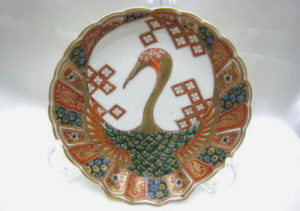
A Kinrande-style plate
Declining Exports and Porcelain for a Wider Public
In the 18th century, the maritime blockade was lifted and Qing-dynasty Chinese ceramics were exported again, causing Imari exports to decline. Producers shifted their focus from export sales to the domestic market. Using techniques such as kagatami-zuri (a type of stencilling) and konnyaku-han (hectographic printing), among others, they employed large kilns to increase efficiency and output. This led to lower-cost, high-volume porcelain production, gradually bringing Arita ware to a wider public.
Meanwhile, from the second half of the 17th century, the Nabeshima clan of the Arita region fired ceramics in its hanyou (domain kiln) as gifts for daimyō and shoguns. Known as Nabeshima ware (Nabeshima-yaki), these included some-tsuke, iro-e and celadon, which was uncommon in Imari. Their restrained beauty also distinguished them from Imari ware.
About the Author: Gustavo Assis

Related Posts
Sou descendente,morei no Japão quase 20 anos, sou apaixonado por cerâmicas e porcelanas, graças a Deus pude comprar muitas peças arita,imari e algumas kutani e satsuma, além de cerâmicas bizem e alguns potes de cerâmica para chá, só sinto que peça kakiemon só adquiri uma,pois os preços são altos. Más me sinto feliz por ter feito parte da sociedade japonesa por tantos anos. Abraços.
Boa noite! Gostaria de saber como tenho certeza se minha cerâmica é uma Arita!
Se alguém puder me ajudar, agradeço!
Para se ter certeza, só a avaliação de um especialista pois existem imitações.