How Clay Changes with Heat: What Happens to Kaolinite in Studio Ceramics?

In handmade ceramics, heating clay is not merely a technical process but a true metamorphosis. Kaolinite, one of the most common components of ceramic bodies, undergoes a series of physical and chemical transformations when exposed to heat. These changes directly affect your piece's final properties, from strength to appearance.
In this post, we will explore what happens to a typical clay, such as kaolinite, during heating, and how these processes influence handmade ceramics.
The Structure of Kaolinite
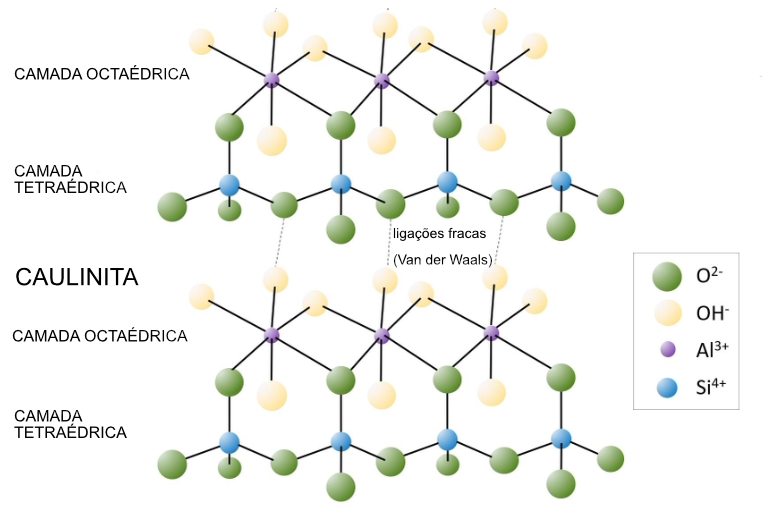
Kaolinite (Al2Si2O5(OH)4) is a clay with a crystal structure of TO layers:
•Tetrahedral layer (T): With silica tetrahedra (SiO2).
•Octahedral layer (O): With aluminium octahedra (AlO6) coordinated to oxygen and hydroxyl groups (OH-).
•These layers are held together by relatively weak bonds, making kaolinite ideal for shaping and ceramic processing.
Transformations during Heating
As kaolinite is heated in the kiln, it passes through different stages of transformation:
1. Loss of Free Moisture (~100°C)
•What happens?
•Free water in the clay's pores evaporates.
•Effect on the piece:
•The piece shrinks slightly but retains its structural integrity.
•Proper drying before firing is crucial to prevent cracking.
2. Loss of Adsorbed Moisture (~300°C)
•What happens?
•Water molecules weakly bound to clay particle surfaces are removed.
•Effect on the piece:
•There is no significant change in microstructure, but the clay begins to harden.
3. Dehydroxylation (~500–800°C)
•What happens?
•Hydroxyl groups (OH-) in kaolinite's octahedral layers are released as water vapour:
Al2Si2O5(OH)4 –> Al2Si2O7 + 2H2O
•The kaolinite structure collapses, forming an amorphous phase called metakaolinite.
•Effect on the piece:
•The clay loses plasticity and structural stability.
•A controlled heating rate is essential to avoid deformation.
4. Formation of Aluminium Spinel (~900–1100°C)
•What happens?
•Metakaolinite begins to reorganise, forming the aluminium spinel (Al2O3 , SiO2) phase, with a cubic crystal structure.
•Effect on the piece:
•The piece gains density and mechanical strength.
•Porosity begins to decrease, marking the onset of vitrification.
5. Mullite Formation and Vitrification (>1200°C)
•What happens?
•The spinel reacts with remaining silica to form mullite (3Al2O3, 2SiO2):
Spinel + SiO2 —> Mullite
•At the same time, some of the silica and feldspar in the body melt, creating a glassy phase.
•Effect on the piece:
•The piece becomes extremely strong, with low porosity and high density.
•Vitrification gives ceramics their characteristic gloss and durability.
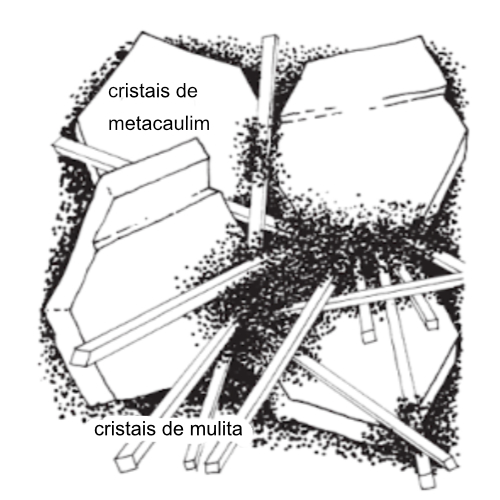
Mullite and metakaolin crystals. Source: Homer, Jane and Frank.
The Importance of These Transformations in Craft Practice
1. Controlling Heating Rates
•Dehydroxylation (500–800°C) and the volume changes associated with spinel formation require gradual heating to prevent cracks.
•A slow temperature rise is particularly important for thick or complex pieces.
2. Effect on Shrinkage
•Most shrinkage occurs up to the spinel formation stage. Plan the initial size of the piece carefully to allow for this reduction.
3. Final Properties
•Mullite formation at high temperatures is crucial to thermal and mechanical strength.
•If the firing temperature is too low, the piece may remain fragile because of insufficient vitrification.
Summary: The Journey of Kaolinite
Up to 300°C: Loss of physically held water.
500–800 °C: Dehydroxylation and formation of amorphous metakaolinite.
900–1100 °C: Reorganisation to form aluminium spinel.
1200–1400 °C: Mullite formation and vitrification.
Each stage transforms clay from a fragile, plastic material into strong, functional and aesthetically pleasing ceramics. Understanding these stages allows you to adjust firing to create durable pieces with distinctive characteristics.
Enjoyed the post? Share your experiences with firing in the comments!
Reference:
- Homer, Jane and Frank. The Potter´s Dictionary of Materials and Tecnniques.
About the Author: Gustavo Assis

Related Posts