
Tomobako – Don’t Throw the Box Away!
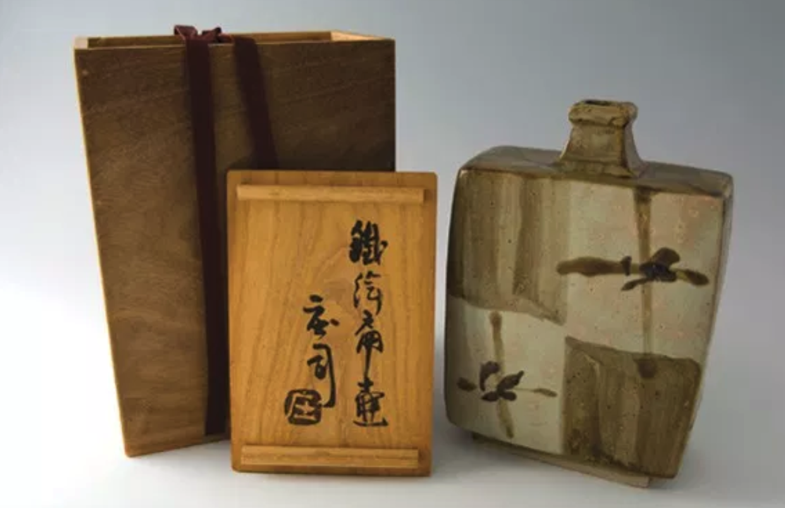
Tomobako
In the West, few people pay much attention to the box after receiving a gift or buying something for themselves. We tend to see it simply as packaging to hold its contents before being thrown away. Apart from the shop’s name and type, it tells us little about what is inside.
This is not the case for many Japanese objects. Packaging is a serious matter in Japan. The box accompanying a work of art is often a work of art in its own right, usually bearing beautiful calligraphy by the potter. In Japanese, the box accompanying a ceramic piece is called a tomobako. The word combines the characters tomo, meaning accompaniment, and hako, meaning box.
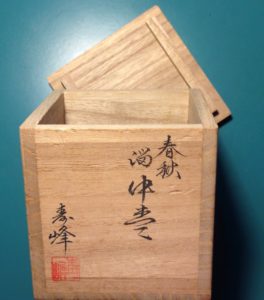
Tomobako
A Box for Ceramics
There is an interesting anecdote about a wooden box and an eccentric gourmet and potter named Fusajirō Kitaōji, better known by his pseudonym Rosanjin Kitaōji. During a trip to Europe in 1954, he visited Picasso. Sidney Cardozo described the encounter in his book The Art of Rosanjin.
When Rosanjin visited Picasso, he brought the celebrated Western artist an example of his pottery. Naturally, it was housed in an exquisite paulownia-wood box. Picasso was fascinated by the softness of the wood and visibly delighted as he touched its surface. Impatiently, Rosanjin thundered: “Not the box, not the box, you silly child! What I made is inside the box!”
I cannot imagine who was more surprised. A master craftsperson usually makes the box, smooths its surface and assembles it using wooden nails or fitted joinery.
The potter then carefully chooses a tying cord that adds elegance to the package while securing the lid. There is a correct way to tie the knot. Even the orientation of the lid receives attention: the wood grain on the sides and lid should match. Some potters stamp both the box and lid to show exactly how they should align.
The box also plays a significant part in determining the value of its contents. In Japan, a work of art may be worth half as much without its original signed box. A box signed by the artist’s child or apprentice can also reduce its value compared with one signed by the artist. For a valuable piece, such as a tea bowl (chawan) by Arakawa Toyozō, the difference in yen can be substantial.
Even famous potters may leave their pieces unmarked. The accompanying box can therefore be one of the few ways to authenticate them. The celebrated potter Shōji Hamada was one example. Here are his thoughts on the subject:
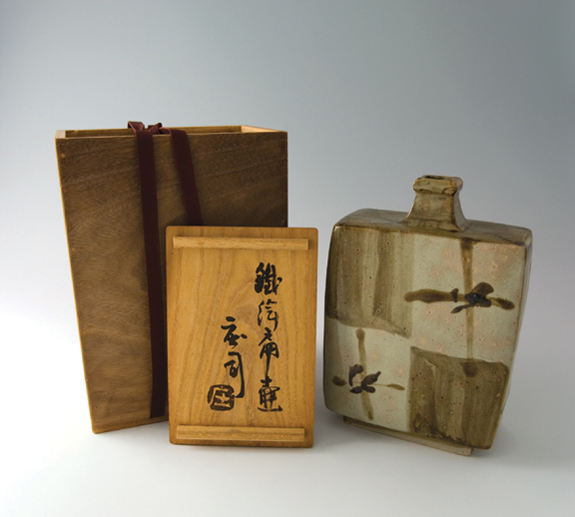
A vase by Hamada and the signed underside of its box lid. Source: Wikipedia
I now think it unnecessary to put a seal or stamp on your work before you have completed a tenth of your life as a potter. This may be interpreted as irresponsible or arrogant. I admit that during my years in Kyoto and my stay in England I marked my work with a stamp, and even put the Leach Pottery’s “S.I.” stamp on my pieces. Since then, I have thought differently about it. In Mashiko, the idea of marking my initials or stamping my pottery quite naturally slipped from my mind. I have subsequently received severe reprimands for not marking my expensive exhibition pieces, and have been attacked as irresponsible. But it should be remembered that, according to Japanese tradition, Japanese buyers always buy the box for this kind of piece, and I have to sign the lid and stamp it. In Japanese tradition, the box authenticates the pottery, so there is no need to mark the piece as well. This leaves me free.”
That is a good reason to keep the boxes in good condition. Many galleries and collectors wrap them to keep them pristine and preserve their value.
As you can imagine, calligraphy is a highly respected art in East Asia, and many potters are also skilled with a brush. Some inscriptions have delicate strokes suggesting incense smoke drifting away. Others are written in bold, strong strokes, imbued with purposeful spontaneity.
Often, a tomobako will have a sheet of paper over it to protect the calligraphy.
The inscription usually begins at the upper right, either on top of the lid or on its underside. Some potters sign the underside of the lid, so make sure to examine the whole box carefully.
The calligraphy can tell us the style, shape, glaze type, year and kiln name. Most potters usually sign their names at the lower left.
The box plays an important role in the value and protection of Japanese ceramics, although the real pleasure comes from taking the piece out and enjoying it in everyday life.
Sources:
- Leach, Bernard. Hamada, Potter, p. 166. Kodansha.
- Yellin, Robert. The box, don’t throw it away. http://www.e-yakimono.net/html/thebox.HTM
About the Author: Gustavo Assis

Related Posts

Estou amando as suas histórias sobre a cultura japonesa. Obrigada por isto!!
Fico feliz que tenha gostado! Obrigado pela leitura!