Raku in the West
Hello! As I wrote in the previous post, there are differences between Raku as practised in Japan and in the West. In this post, I will discuss my experience with Raku here in Brazil.
Raku: the event
My experience with Raku took place at the studio of potter Newton de Mello in Barra da Tijuca, Rio de Janeiro. It is a very enjoyable event, with food and drinks, and the pieces are ready the same day.
We begin by applying resists, using tape, paraffin wax or latex, to the bisque-fired piece. When the glaze is applied, areas covered by resist remain unglazed and will turn dark. I will explain the chemical process shortly.
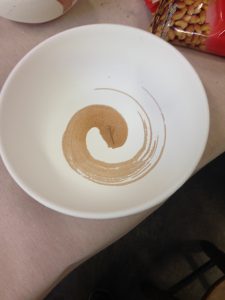
We apply the glaze and remove the resist. Paraffin wax does not need to be removed, as it melts during firing. In the example below, the swirling design is the area covered in paraffin. It will darken after firing.
Before firing
Firing
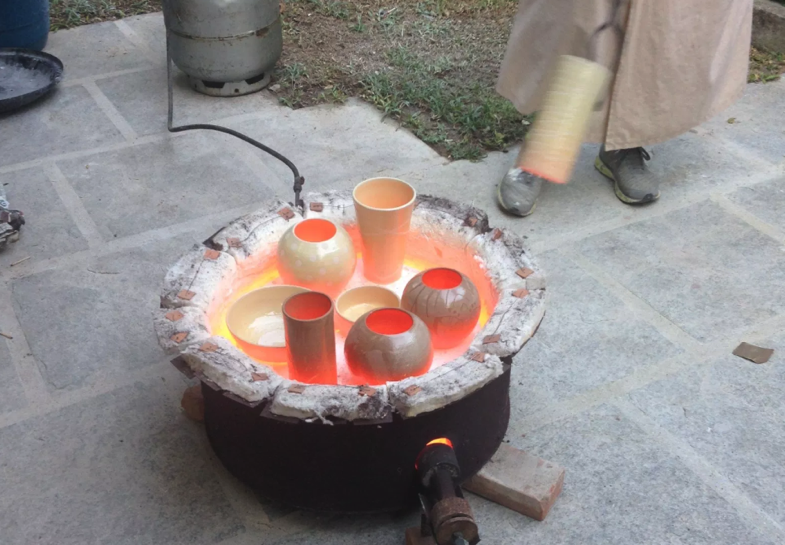
We then place the pieces in the kiln. It is gas-fired and, as you can see, quite simple. Relatively low temperatures, up to 900°C, are reached inside.
Raku is a low-firing technique. Initially, firing takes place in oxidation, after which the piece is placed in a reduction chamber. But what do oxidation and reduction firing mean?
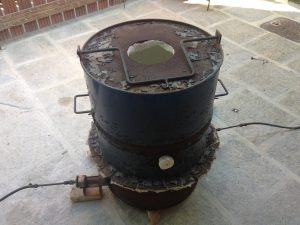
Raku kiln
Oxidation firing takes place when oxygen molecules are abundant inside the kiln, allowing chemical processes to proceed without a shortage of that element.
Reduction firing takes place in an atmosphere with limited oxygen. “Reduction is incomplete combustion of fuel, caused by a shortage of oxygen, producing carbon monoxide” (Arbuckle, 4). Carbon monoxide and other reducing gases can react with oxygen in certain oxides in the glaze and clay. These reactions change the oxidation state of the elements and may alter the materials’ colours. In Western raku, smoke and combustible materials can also deposit carbon on the surface and in the pores of unglazed areas, blackening them. This carbon blackening should be distinguished from the chemical reduction of oxides.
Here, the gas kiln operates in oxidation. When its interior reaches approximately 900°C, the lid is removed and the still-glowing piece is transferred to a chamber and covered with sawdust. The chamber is then closed, and post-firing reduction takes place inside while the piece is still hot.
-
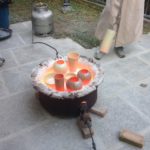
- Removing the kiln lid
-
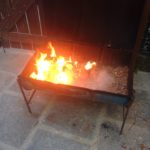
- Reduction chamber
The piece remains in the reduction chamber for a few minutes before being plunged into cold water, stopping the firing process and creating the characteristic crazing.
-
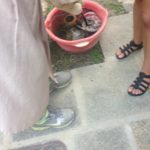
- Immersion in water
-
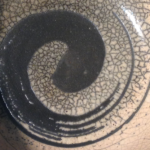
- Finished piece
Raku is a distinctive form of ceramic production. Its uniqueness lies in the range of effects that can be created simply by changing certain variables. These include wax resist, glazes, temperature and time, which ultimately determine the result of firing a clay piece. The still-glowing pieces are removed from the kiln and subjected to extreme thermal shock in cold water. In this encounter between the elements, raku's magic takes place: unexpected results ensure that no two pieces are alike. It gives material form to a Zen Buddhist idea: the events of our lives are unique and transient.
About the Author: Gustavo Assis

Related Posts