
Shino glaze – illusory simplicity
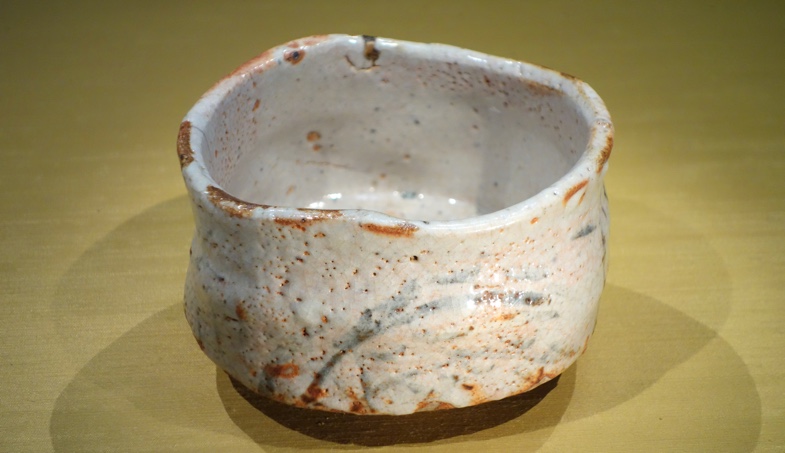
Shino ware
Shino ware came from the Mino kilns in Toki, Gifu Prefecture, Japan. Its pieces were famous for their thick, “snow-white” glaze with scarlet flame-like markings that seem to lie just beneath the glaze layer. Shino is also the name of the glaze developed in these kilns during the Momoyama era (1573–1615). At a time when white ceramics were highly valued, Shino was created to satisfy that desire. It fascinated generations of Japanese people and inspired Yasunari Kawabata's novel Thousand Cranes. Typical Shino forms include tea bowls and small to medium-sized dishes for the tea ceremony.
The great Japanese potter Toyozō Arakawa, responsible for rediscovering Shino's characteristic techniques in the 20th century, said:
“Of all things, Shino expresses the deepest Japanese taste.”
Today, many renowned Western potters use Shino glaze, which is appreciated both in Japan and abroad.
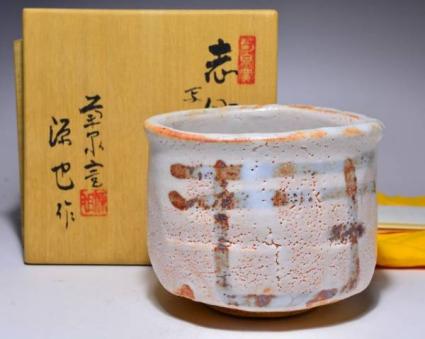
Shino chawan with tetsu-e decoration
Shino glaze
Generally, its sole ingredient is feldspar, although some authors say it was originally a mixture of feldspar and ash. The glaze is usually applied thickly.
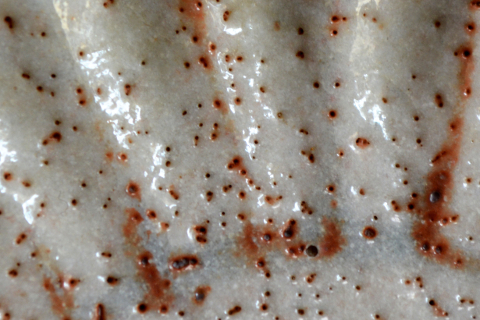
Close-up of Shino glaze. Source: touroji.com
A thick application increases the piece's whiteness and encourages small holes in the glaze (pinholes), both desirable qualities in this case. However, it may also produce unwanted results: incomplete melting, excessive melting and running, or a failure to develop scarlet markings. In fact, the proportion of Shino pieces that emerge from the kiln with satisfactory results is not very high.
- An example of a Shino glaze composition: Hiratsu feldspar 100%.
Hiratsu feldspar has a distinctive chemical composition, closely resembling nepheline syenite.
A distinctive feature of Shino glaze is the random appearance of scarlet pinholes across its white surface. Connoisseurs greatly appreciate the contrast between the white glaze and these pinholes, and one could say that each Shino piece has its own individuality.
Additional tetsu-e decoration, painting with iron oxides, is also common, giving Shino a broad decorative range.
The clay
Choosing the clay is essential to bring out Shino's whiteness. White porcelain is not recommended, as there would be little tonal difference between the glaze and the clay. On the other hand, iron-rich clays have a negative effect on the whiteness of Shino glaze. Low-iron clays are preferable to avoid colouring from iron particles. Mogusatsuchi, a clay commonly used for Shino, readily develops scarlet spots and has low firing shrinkage. Its iron content is also low, around 1.5%, making it compatible with Shino glaze. The clay has a light texture, and its minute iron particles bring out the scarlet colour.
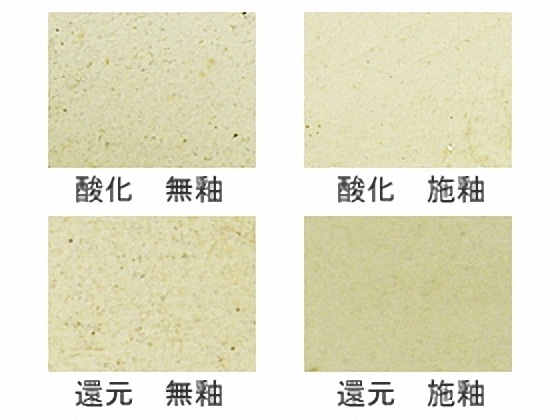
Figure: Mogusatsuchi clay after firing. Top left: unglazed, oxidation; top right: glazed, oxidation; bottom left: unglazed, reduction; bottom right: glazed, reduction. Source: Tougeishop.com.
Final firing conditions
Let us now look at the final firing method. It is generally described as “raising the temperature slowly, then lowering it slowly over the same length of time”.
In a wood kiln fired over several days, it takes 2 to 3 days to reach 1,200°C. After passing 900°C, the piece “breathes” gas in a reducing atmosphere as the temperature continues to rise.
Cooling from the highest temperature to 900°C, when the scarlet colour becomes established, takes a full day. The temperature falls slowly, and the same number of days used to raise it are devoted to gradual cooling.
The scarlet colour that accumulates on the surface is attributed to iron(III) oxide, or red iron ore. With rapid cooling, the iron(III) oxide cannot reach the surface. It is also known that the scarlet colour does not develop unless a reducing atmosphere is maintained during slow cooling.
These are the essential conditions for developing the scarlet colour:
- Minute iron particle content: 1 to 1.5%.
- Gradual heating: 15 to 17°C per hour.
- Gradual cooling: down to 900°C, at 10 to 12°C per hour.
- Kiln atmosphere during gradual cooling: reducing.
Historically, Shino kilns were partly underground, damp and inefficient. Incomplete combustion in the firing chamber seems to have encouraged more interesting results.
Shino is a glaze with a simple composition, yet achieving good results presents challenges. Its characteristic scarlet colour, for example, requires particular conditions. It is not merely a simple glaze: Shino's difficulty lies in adjusting complex conditions, including those of the final firing.
Sources:
- Craig, Euan. The Principles of Shino. http://euancraig.blogspot.com.br/2009/03/principles-of-shino.html
- 志野釉.
- Wilson, Richard L. Inside Japanese Ceramics – A Primer of Materials, Techniques, and Tradition. Weatherhill.
- Video – 豊蔵志野 挑戦から創造へ.https://www.youtube.com/watch?v=Hjs9IdQ4lCU
About the Author: Gustavo Assis

Related Posts
Very good!!!!
Thank you very much!