Lost in Translation: Wabi-Sabi
After living in Japan for three years, I realise I have only scratched the surface of Japanese culture. Many differences in values and perspectives make it difficult for us Westerners to understand the East.
I read that the words for translating and betraying share a common root. On the subject of words, Nietzsche wrote:
How pleasant it is to hear words and sounds! Are words and sounds not rainbows and illusory bridges between things eternally separated?”
Even if words are illusory constructions and translation a betrayal of words, we try to bridge the divides between individuals and cultures, because the loneliness of being unable to communicate is unbearable for most of us. Despite the imperfections inherent in words and translation, I believe they can help us grasp certain general concepts and gradually build a fuller picture, allowing a better understanding of the culture we are studying.
For me, the expression wabi-sabi represented a first step towards unravelling the enigma of the Japanese ideal of beauty.
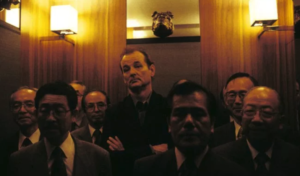
Scene from the film “Lost in Translation” (released in Portuguese as “Encontros e Desencontros”)
The concept of wabi-sabi is often presented as inexplicable. We Westerners, in turn, come to see this representation of the inexplicable as an aspect of Japanese culture's sophistication. We lose something in this misunderstanding, failing, for example, to appreciate Japanese artworks. Or we produce copies that do not directly embody the concept, creating mere pastiches.
But are wabi-sabi and so many other Japanese concepts of beauty really so inaccessible to us? I do not think so. For me, wabi-sabi is a concept that, although very important, can be interpreted within our Western culture. Apart from those who wish to create an aura of mystery, many people who say they cannot explain it do so because, deep down, they have not fully grasped the concept themselves.
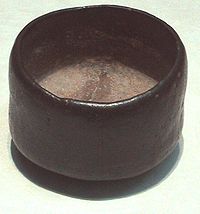
Black Raku
Recently, I read a text in Japanese that sheds light on the subject. In it, tea ceremony master (sadō) Sōshin Kimura says that Japanese people have traditionally cultivated an indirect way of naming and defining their aesthetic values, based on the understanding that traditional Japanese culture rests on sensitivity and feeling. However, he disagrees with the idea that, unlike Western aesthetic values, Japanese aesthetic sensibility cannot be explained logically.
How, then, can we explain wabi-sabi? According to him, wabi and sabi bring together two words with different meanings in a single expression. In my own free translation, he explains:
Sabi is the word for the beauty we perceive in things. As time passes, the things in our world become dirty, decay and break. This is generally seen as deterioration, but these changes also intertwine, and we call this diversity of distinctive beauties sabi. Wabi, in turn, represents acceptance of this ageing (sabire) or soiling (yogore): an emotional disposition to appreciate it and adopt a positive attitude towards it.”
If sabi is outwardly expressed beauty, wabi is the richness of inward beauty. Although the words have different meanings, they represent two sides of the same coin.
We can perceive beauty in Japanese ceramics without knowing their conceptual foundations. Yet a better understanding of those foundations brings us closer to the artist who made the work and broadens our appreciation. For artists, technique is of little value without a grasp of the ideas that underpin their work. Japanese aesthetics can certainly be drawn on by Western artists wishing to enrich the aesthetic qualities of their practice.
I would like to explore more Japanese aesthetic concepts on this blog. Through this mosaic of ideas, I believe we can build a clearer picture of the subject.
Until then! :-)
Sources and Suggested Reading:
- Noma, Seiroku. The Arts of Japan – Late Medieval to Modern. Kodansha.
- In Search of Wabi Sabi with Marcel Theroux. Video. BBC.
- 「わび・さび」の意味を説明できますか?. Courrier Japan, Blog. 30 April 2014. www.courrier.jp/blog/26860/
- 「わび・さび」、茶の湯こころと美. Omotesenke Fushin'an Foundation. www.omotesenke.jp/list2/list2-3/list2-3-1/
- Nietzsche, Friedrich. Assim falou Zaratustra. www.ebooksbrasil.org
About the Author: Gustavo Assis

Related Posts