
Portuguese Faience
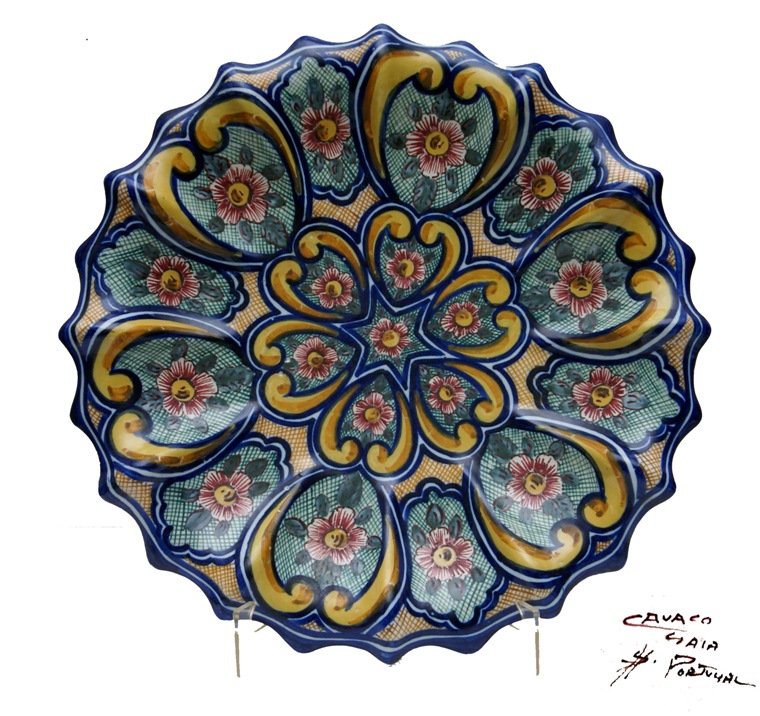
Hello! I would like to introduce a type of ceramics that greatly influenced Brazil: Portuguese faience.
Portuguese faience is a ceramic with a porous body, usually coated with a glaze opacified by tin oxide to provide a white ground for decoration. Opacification should be distinguished from colouring: tin contributes to the opaque white ground, while painted colours come from the pigments used. Products include dinner and tea services, cups, mugs, plates and decorative pieces. They were often more affordable than Chinese porcelain and enjoyed considerable popularity.
Origins:
During the Moorish invasion of the Iberian Peninsula, potters began producing wares in a tradition dating back to ancient Egypt. The Balearic Islands—of which Mallorca is the largest—became a trading centre for exporting these wares to Italy and France. They subsequently became known as maiolica.
From the 14th century onwards, however, Faenza in northern Italy became an important centre for ceramics made using techniques similar to those introduced through Iberian-Moorish culture. The name faience comes from the French form of Faenza and came to designate wares of this kind, including those later made in Portugal.
The terms maiolica and faience have historical and regional uses relating to tin-opacified glazed ceramics. They should not be distinguished solely by glaze coverage on the front and back or by the piece’s position in the kiln. These features need to be examined in documented examples and processes.
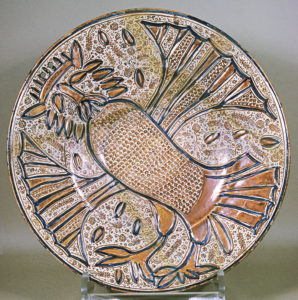
Hispano-Moresque plate, c. 1525–1550. Manises, Valencia. Walters Museum. Source: www.wikipedia.com
Marks left by firing supports can help explain how a piece was placed in the kiln. Their location depends on the supporting and firing arrangement; it does not, by itself, provide a universal definition of maiolica or faience.
Faience in Portugal:
According to Casimiro, Portuguese faience can be divided into 6 chronological and stylistic phases. This week I will write about the first three.
Period I: 1520–1570
This marks the beginning of tin-glazed ceramic production in Portugal. It was made on the south bank of the Tagus and in Lisbon at least from 1561. Strong demand for wares from Spain seems to have encouraged local production.
Period II: 1570–1610
Production in this period drew on Spanish and Italian wares and Chinese Ming-dynasty porcelain (1368–1644). Perhaps under East Asian influence, wares with blue designs on a white ground began to be produced.
Initially intended for wealthier customers, these wares later became cheaper and accessible to a wider public.
Period III: 1610–1635
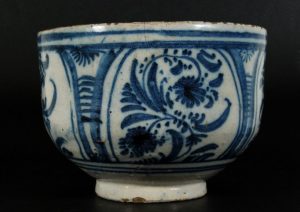
Portuguese faience bowl, 17th–18th century, attributable to the Monte Sina factory
Minor defects, a loss and a hairline crack
Diameter: 17 cm. Source: www.bestnetleiloes.com
Portuguese faience production became established and achieved considerable technical development. East Asian influence continued in its subjects, and copies grew closer to their models. At the same time, designs inspired by local culture emerged. Coats of arms on the wares indicate that they were made for privileged families.
Besides plates and bowls, bottles and jugs were now produced, the latter with elaborate handles that were twisted or inspired by branches and leaves.
Until next week, when I will continue the history of Portuguese faience! :)
Source:
- Casimiro, Tânia Manuel. Revista Portuguesa de Arqueologia, Vol. 16 / 2013.
- Faiança Portuguesa. http://mercadoantigo.weebly.com/faianccedilas.html
- Aronson, Robert. Majolica, Faience and Delftware. www.antiquesandfineart.com/articles/article.cfm?request=248
About the Author: Gustavo Assis

Related Posts
gostaria de saber mais. sobre “borrões”
Olá Layde, obrigado pela leitura e pela pergunta.
Pelo o que eu li, o borrão (ou flow blue em inglês) é um tipo de cerâmica azul sobre fundo branco onde os desenhos azuis aparecem borrados. Normalmente vistos em cerâmicas de baixa queima (faiança) mas também encontrado em porcelanas. Suas origens são por volta de 1820 em Staffordshire, Inglaterra, e tinha como método de produção a reprodução de desenhos por cópias. Uma placa de cobre com pigmento de cobalto (transferware) imprimia os desenhos na peça. Talvez por um erro na hora de transferir o padrão, o desenho ficava borrado. Eventualmente, esse erro foi sendo apreciado e repetido. Hoje em dia existem muitos colecionadores que buscam esse tipo de peças.
Espero ter ajudado!
obrigada!!!
Boa noite Gustavo muito bonita suas peças gosto muito de cerâmicas trabalho em uma em Petrópolis empresa Luiz Salvador comecei na pintura atualmente trabalho em fornando louças de terceira queima gostaria muito de ter oportunidade de trabalhar em uma cerâmica em Portugal
Olá Carlos! Obrigado! Espero que você concretize seu sonho de trabalhar em Portugal! Um abraço!