Translucency in Hotaru-de Ceramics
What is hotaru-de
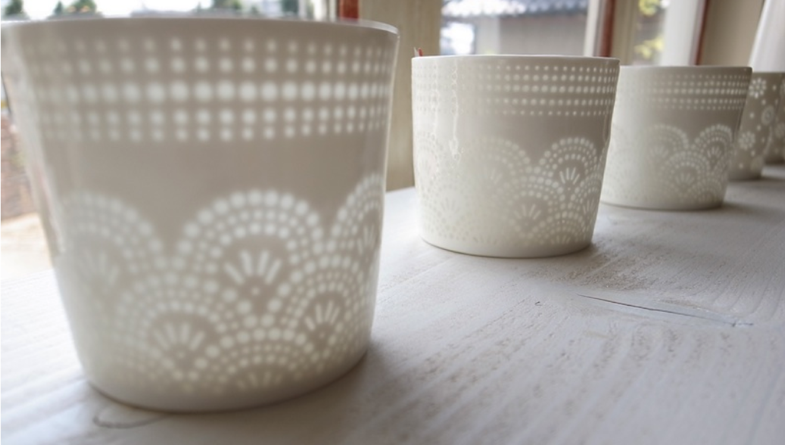
Hotaru-de (literally, “firefly hand”) is a method in which a pierced piece (sukashi-bori) is coated with glaze and fired. In short, openings made in the surface are filled with glaze. The hotaru-de technique is considered a development or application of sukashi-bori.
The light passing through the piece resembles the glow of fireflies, hence the name. Early examples of hotaru-de come from Persia, now Iran, in the 12th century, and from Ming-dynasty China from the 15th century onwards.
In Japan, this technique is often seen in Arita and Hizen porcelain, where examples are comparatively numerous. This may be because porcelain clay is particularly suitable for making the fine cuts and openings that glaze fills to create almost transparent areas. Porcelain is also translucent, complementing the light effects of hotaru-de.
Care must be taken with the thickness of the clay. If the body is thick, the pierced openings are large and the glaze cannot cover them completely. If it is too thin, even small openings allow the glaze to run through without filling them.
Hotaru-de pieces must therefore be carefully pierced with small holes, coated with a highly viscous glaze that flows little, and fired at a high temperature. Highly transparent glazes are used to emphasise the sukashi-bori.
This allows light to pass through the glaze while retaining its brilliance, creating an interesting contrast between light and shadow.
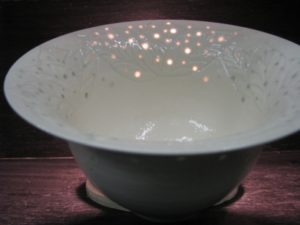
Source: saideigama.com
The Technique
The technique is distinguished by small openings with a surface area of 3 to 5 mm2 . Once the openings have been pierced and finished, the vessel is bisque-fired. They are then filled with a translucent but non-fluid glaze rich in feldspar. A mixture of 85% feldspar and 5–15% transparent glaze is the standard formula. The glaze suspension is thickened with a binder such as seaweed syrup (funori) or gum. This glaze is brushed into the openings. The entire piece is then covered with a transparent glaze and fired.
Sukashi-bori may be carried out when the clay is partly dry or completely dry, depending on the number of openings. For example, two or three small holes can be made without difficulty while the piece is partly dry.
However, decoration with many openings, as in the image above, would be impossible in partly dry clay. The soft body moves as precise holes are cut, making it difficult to work. The hotaru-de piece shown was therefore presumably pierced with a fine drill when completely dry.
The openings measure between 0.5 and 2 mm. Larger holes are difficult to fill completely with glaze, and the more a piece is pierced, the weaker it becomes.
Porcelain, however, can be fully fired at high temperatures, from 1,200°C to 1,300°C. As noted above, its strength makes it well suited to hotaru-de. The chosen glazes are transparent, flow little and melt at high temperatures: high-fire glazes. Transparent to slightly opaque glazes work well with whitish clay bodies.
In short, hotaru-de uses the passage and interruption of light as a decorative effect.
Source:
- http://touroji.com/technique/sukashiboritohotarudenogihou.html
- Wilson, Richard. Inside Japanese Ceramics, A primer of materials, techniques and traditions. Ed. Weatherhill.
About the Author: Gustavo Assis

Related Posts