
Shibui and the Buddhist Ideal of Beauty
Hello!
This week I would like to continue exploring Japanese aesthetics. On another occasion, I discussed the expression “wabi-sabi”. This time, I would like to introduce the concept of “shibui”.
The dictionary gives two distinct meanings. The most common in Japanese relates to an astringent taste, such as an unripe persimmon or a dry wine. Here, however, the meaning of shibui that interests us is different. Before explaining it, let us look at its origins:
Origins
The term emerged in tea ceremonies, which aim to offer participants a sense of communion and inner peace. As the ceremony developed, tea masters established etiquette, selected utensils, and arranged tea rooms and gardens to encourage a meditative state among participants.
The Japanese intellectual Sōetsu Yanagi, mentor to the potters Shōji Hamada and Bernard Leach, wrote that the tea ceremony is an aesthetic manifestation of Zen Buddhist practice. The aim of the Zen school is enlightenment (satori) through meditation. Meditation is a state to be reached not only in temples but also through traditional Japanese arts, such as the tea ceremony. Here we see the common link between Zen and the tea ceremony. This school originated in India, and the Chinese character for Zen (禅) is a transliteration of the Sanskrit term dhyāna, meaning meditation or contemplation.
The Utensils
In this spiritually focused setting, tea ceremony utensils are selected for both their practical function and their aesthetic value. Ceramics, especially tea bowls (chawan), play an important role in the ceremony, and time is set aside for participants to examine them closely, from rim to foot.
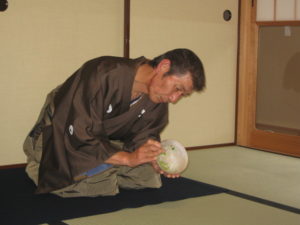
Appreciating a chawan. Source: pds.exblog.jp/pds
Defining the Concept
Various terms emerged as criteria for selecting and appreciating these utensils and art more generally, and also became common in Japanese aesthetics. Shibui is one of them, with no direct equivalent in Portuguese. According to Yanagi, close adjectives include “austere”, “restrained” and “subtle”. The beauty it expresses is inward-looking. Its opposites would be “ostentatious”, “vulgar” and “showy”. Drawing a parallel with Zen Buddhism, we see that silence and austerity are qualities and instruments of spiritual development. As in Christianity, poverty and humility also fit within Zen Buddhism's “philosophy of emptiness”.
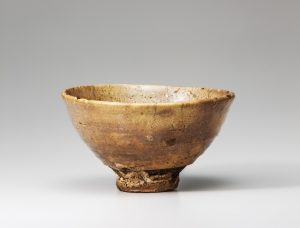
“Kizaemon” tea bowl. Sixteenth century, Korea. Daitoku-ji Temple, Kyoto, Japan.
In this sense, a piece described as “shibui” has muted colours, little or no decoration, and a simple form. As for distortion, Yanagi says it should be spontaneous, arising from the craftsperson's purely intuitive work. Indeed, some of the most highly regarded bowls in the tea ceremony world were made by humble Korean potters of the Joseon era (1392–1897). Their unpretentious, simple and, in a sense, impoverished character, yet great vitality, captivated admirers and aptly captures the spirit surrounding the term shibui.
Source:
- Yanagi, Sōetsu. The Unknown Craftsman. Kodansha USA.
About the Author: Gustavo Assis

Related Posts

Caro Gustavo, muito obrigado por esta magnífica explicação. Vivi no Japão e pratiquei a arte do chá e outras. É outro mundo e outro caminho de vida. Bem-haja!
Olá Jorge! Muito obrigado pelo comentário e pela leitura! Um abraço!