Indigenous Ceramics of Brazil – Part II
Hello!
This week I continue the subject by describing ceramic use in particular ceremonial contexts. I am drawing on Suma Etnológica Brasileira, Vol. 2. The accounts should be read within their historical and cultural contexts, without generalisation to all Indigenous peoples of Brazil.
Introduction
Although this post focuses on ceramics for ceremonial use, everyday Indigenous wares also bear animal motifs, geometric patterns and other designs with more than a merely formal significance. As Gordon R. Willey writes, utilitarian and ceremonial ceramics overlap in use. Vessels worn through daily use are found inside funerary urns, serving as containers for offerings to the dead.
Although ritual ceramics generally have more elaborate finishes, highly accomplished pieces are also used in everyday life.
I have selected some interesting pieces from particular Indigenous peoples.
The Tukâno People and the Vessel for yajé
Among the Tukâno of northern Amazonia, there is a ceremony in which people drink an infusion of a hallucinogenic vine called yajé. The vessel used to hold and serve the vine extract differs from every other type made by this people, and accounts of it are rare. According to researcher Gerardo Reichel-Dolmatoff in Os Alucinógenos e o Mundo Simbólico:
This vessel is an important ritual object, about 25 cm tall, with a globular body, a tall cylindrical base and two small handles on the rim of the opening. The handles are pierced so that a cord can be passed through them to carry or hang the vessel. The yajé pot (gahpí soró) must be made by an elderly woman who uses a special, very hard, smooth yellow stone to smooth and polish the inside and outside surfaces. The Tukâno interpret this stone as a “phallus that shapes” the vessel, which is a uterine receptacle. (…) On its naturally dark exterior, the vessel bears polychrome painting in white, yellow and red; the first two colours represent the principle of fertilisation, and the last, fecundity. A vagina and clitoris are sometimes painted on the cylindrical base, representing the “door”. When not in use, the yajé vessel is stored hanging from a pole outside the house, beneath the projecting roof; when yajé is prepared, however, dust is cleaned from the vessel and its painting may be retouched. Before use, it must be purified with tobacco smoke, as must the stick used to stir the drink before consumption. Once filled, a man carries it inside the house and places it in a dark location
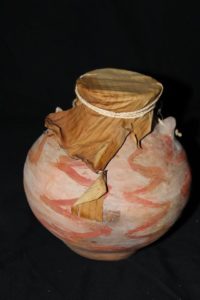
The source identifies the image as a Marúbo piece; it does not document the Tukâno vessel described in the quotation. Ceremonial vessel for drinking yagé, attributed to the Marúbo, an Indigenous people of the Pano language family who live in the south-west of Amazonas state, in the Vale do Javari Indigenous Territory. Source: https://www.artesanatodajaci.com.br/
According to the Tukano, the aim is to return to the womb (…) where the person now “sees” the community’s deities, the creation of the Universe and Humanity, the first couple, and the creation of animals (…) During the ritual, the person enters through the vaginal “door” painted on the vessel’s base and, inside the receptacle, joins the mythical world of Creation. (…) This return to the womb also accelerates time and is equivalent to death. In the people’s words, the person “dies” but soon revives in a state of wisdom: on awakening from the trance, the individual sees the truth of their religious system confirmed, having witnessed its personifications and mythical scenes
The Tukano’s visions also inspire geometric designs and animal and human motifs used to decorate various media, including ceramics.
The Waurá People and the nukaatsen
The Waurá of the Upper Xingu are presented in this account as highly accomplished potters. It also mentions the abduction of women by neighbouring groups. This statement requires historical contextualisation in the source and should not be taken as a description of present-day relations between these peoples.
Among their cooking pots, jars and other vessels, the ceremonial piece called nukaatsen is used to boil water for the boys’ ear-piercing rite.
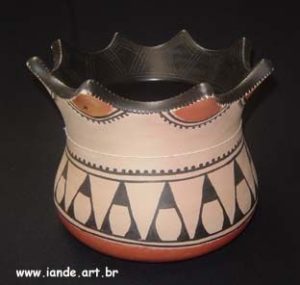
Waurá nukaatsen. Source: http://www.iande.art.br/
The exterior is painted red with fingers or a wad of cotton. This pigment, described in Part I, is made by adding annatto to a clay ball and firing it. The fired ball is scraped, and its powder mixed with water and painted on before firing. Afterwards, the same area receives another coat of annatto with pequi oil to intensify the colour.
Lightning, lines and diamond shapes are painted with a dark pigment made by macerating a shrub, possibly of the genus Eugenia. This pigment also coats the interior, which is fired again with straw and tree bark that produce abundant smoke. Repeated several times, this process deposits soot inside the vessel, forming a very durable coating.
The Karajá People and Their Dolls: litxocô
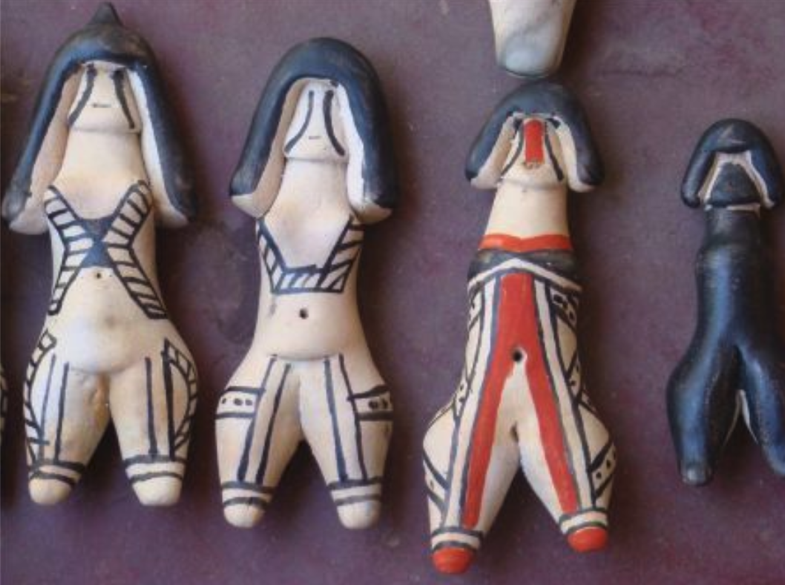
The Karajá are also highly accomplished potters, and their work includes dolls, which they call litxokô. Although not used in religious rituals, these dolls communicate Karajá myths and social organisation to young people, going beyond a purely recreational role for children.
On 25 January 2012, IPHAN’s Consultative Council approved recognition of the knowledge and practices associated with making Karajá dolls, and their artistic and cosmological expression, as Cultural Heritage of Brazil, in the Books of Knowledge and Forms of Expression.
According to the Goiás anthropological museum’s website:
Through ceramic dolls, Karajá women represent the material and symbolic world of the Iny people*, through the art of modelling clay and decorating the pieces.
* – Iny means “we” in the Karajá language
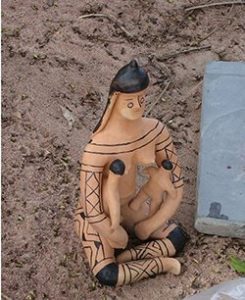
Karajá doll. Photograph: Iphan Collection / Telma Camargo
There are two stylistic patterns among the dolls. The first, from before 1940, consists of separate, small, upright and extremely rigid figures. The navel is pierced, as is the mouth, though the latter sometimes has only an incision. Alongside body painting, the hair, painted black, suggests the figures’ sex. Although other Karajá ceramics were fired, dolls from this period were made from unfired clay. As Tânia Andrade Lima notes, this was certainly intentional, but the reasons are unknown.
After this phase, perhaps with the stronger presence of Western European culture, the Karajá began modelling figures seated, grouped together or representing everyday scenes. Limbs became more differentiated, and the dolls began to be fired.
That is all for now! I hope you enjoyed it, and I look forward to seeing you in the next post!
Source:
- R. Willey, Gordon and Andrade Lima, Tânia in Suma Etnológica Brasileira 2 – Tecnologia Indígena. Edited by Berta G. Ribeiro. Published by Vozes.
- Universidade de Goiás, Bonecas Karajá: Patrimônio Cultural Imaterial do Brasil.
https://www.cienciassociais.ufg.br/n/19655-bonecas-karaja-patrimonio-cultural-imaterial-do-brasil - Enciclopédia dos Povos Indígenas no Brasil – Instituto Socioambiental, Iny Karajá. https://pib.socioambiental.org/pt/povo/iny-karaja/print
- UFG – Museu Antropológico, Bonecas Karajá. https://www.museu.ufg.br/p/1322-bonecas-karaja
About the Author: Gustavo Assis

Related Posts