From Code to Earth: When the Project Meets Matter
Hybrid prototyping experiments between digital fabrication, ceramics and earth construction.
Between Digital Design and Matter
Digital fabrication has become a routine presence in architectural education. We model objects on the computer, prepare files for cutting or printing machines, and observe digital instructions turn into material form.
Yet most of these experiences take place with industrial materials, such as the polymers used in desktop 3D printers. While these technologies help in understanding important principles of geometry and fabrication, they rarely offer opportunities to engage with the behaviour of materials used in building, such as earth.
3D printing with earth is already a subject of research and specialised applications, but the machinery, material preparation and required expertise can restrict access within educational contexts.
During my Master’s research, I sought to explore a complementary path: how can relatively accessible digital tools be used to experiment with earth-based materials, without relying on dedicated 3D-printing systems?
The aim was to create learning situations in which digital design and manual experimentation could mutually inform one another. To this end, I developed three experiments exploring different relationships between geometry, matter and fabrication.
Experience 1: Drawing on Earth
The first experiment began with a relatively straightforward procedure: transferring a digital geometric pattern onto a surface coated with earth render.
I drafted the design in vector software and used a laser cutter to produce a paperboard stencil.
The stencil was placed onto an earth render that was still plastic, although already dry to the touch. Light taps with a hammer helped establish contact between the stencil and the render, transferring the pattern onto the surface.
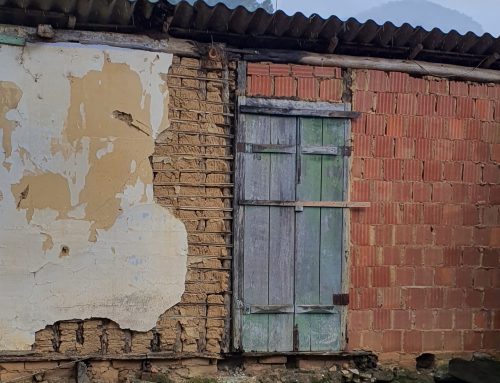
The earth was collected from an earth wall that had collapsed on the NOVA FCT campus.
When the stencil was lifted, the pattern remained imprinted in the render. The recessed areas could later receive coloured clays or earth washes, making the design more prominent.
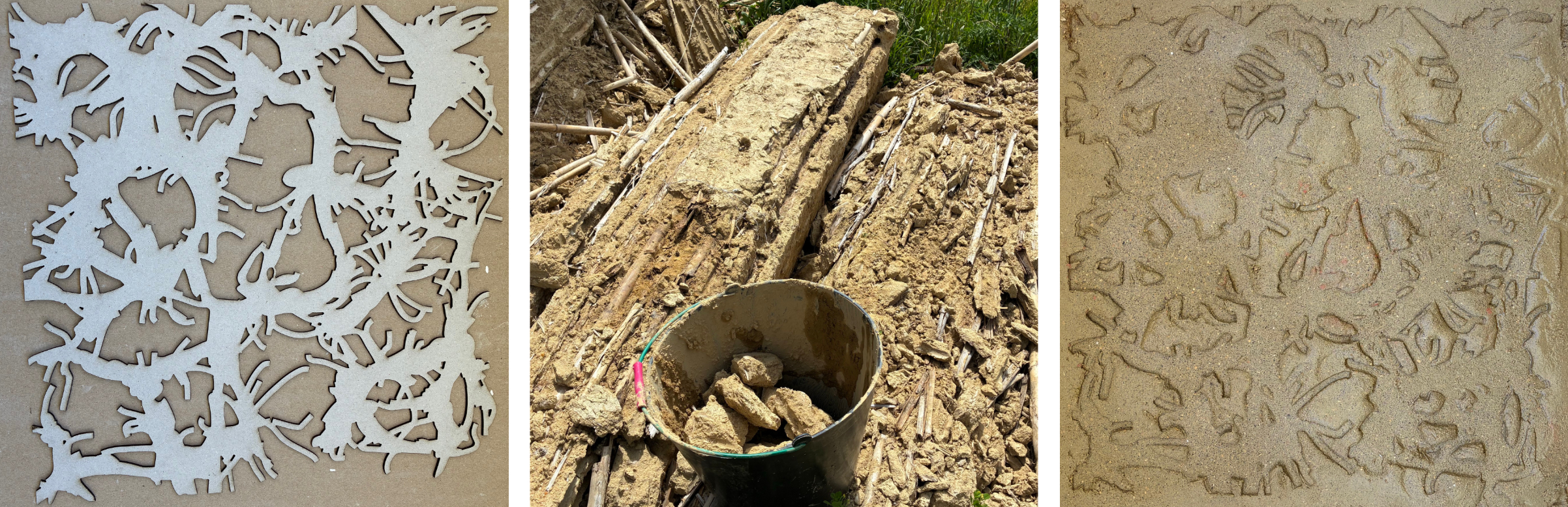
Figure 1 — Laser-cut stencil, gathered earth and a pattern transferred to the earth render. Images: Gustavo Assis.
The experience revealed an opportunity for dialogue between digital tools and manual finishing techniques.
The design generated on the computer was not merely reproduced by a machine. Its transfer depended on the condition of the render, the plasticity of the earth and the manner in which the stencil was applied.
The digital tool allowed the pattern to be prepared, but it was contact with the material that determined its inscription on the surface.
Experience 2: 3D Printing
In the second experience, I used an algorithmic geometry to produce an object on a filament-based 3D printer using PLA.
Prior to printing, the digital model had to be processed by slicing software, or slicer, responsible for translating the geometry into machine instructions.
This stage brought to light some of the constraints inherent in additive manufacturing.
Certain overhangs and inclined planes required support structures for printing to succeed. The software identified these conditions and automatically generated the necessary supports, which were subsequently removed by hand after fabrication.
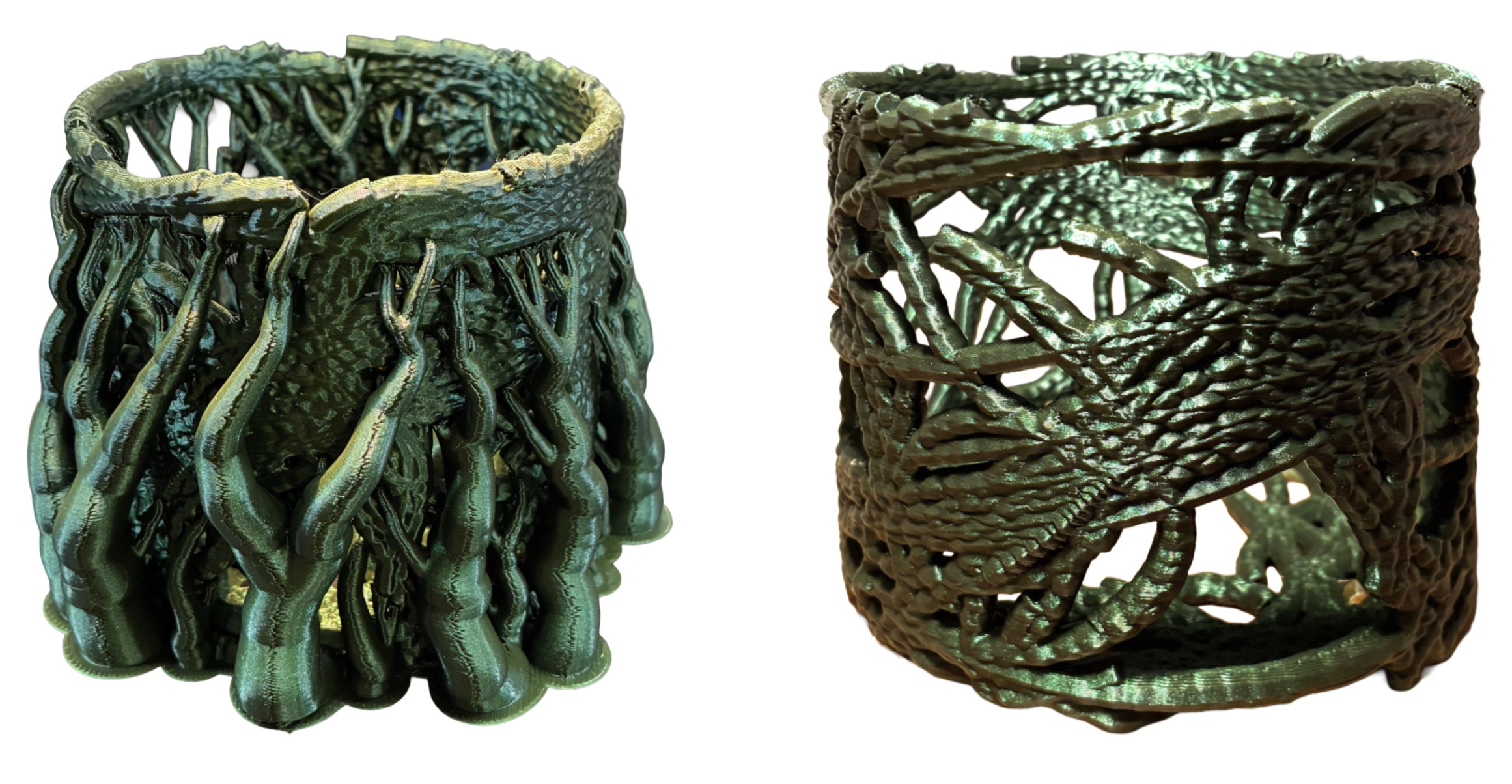
Figure 2 — Two views of the prototype made by 3D printing in PLA. Photographs: Gustavo Assis.
The purpose of this experience was not to simulate the behaviour of earth through plastic.
PLA and earth mixtures have profoundly different properties. However, the successive deposition of material in layers makes visible certain geometric conditions that must also be reckoned with in 3D printing with earth.
The experience brought a crucial point into focus: a digitally conceived form is not necessarily a form that can be fabricated without adaptation.
Between the model and the object lie procedures, machines and material limits that actively shape the outcome.
Experience 3: Material Agency
The third experience engaged most directly with my ceramics practice.
The objective was to construct a cylindrical earth form derived from an algorithmic pattern printed on paper.
For this, I used earth gathered from the same site as the first experiment, to which I added small amounts of commercial clay and pine needles to improve the mixture’s plasticity and introduce fibrous reinforcement.
The initial strategy involved transferring the pattern onto a flat slab of earth and subsequently rolling it around a cylindrical mould.
However, the slab cracked during the attempt to form it.
The procedure failed to produce the intended geometry.
This outcome prompted me to reconsider how the geometry might be built. Rather than insisting on transferring a continuous surface into a volume, I sought a solution that would allow the object to be formed in parts.
Coil Building
I laid the printed pattern on the table, protecting it with transparent film to prevent the earth from adhering to the paper.
I then hand-rolled coils of earth and laid these elements along the lines of the drawing, following the algorithmic geometry in a flat state.
After assembling roughly half of the form on the worktable, I transferred it onto a cylindrical PET bottle that served as a temporary armature.
The structure was carefully adjusted to the curvature of the support.
I repeated the procedure to produce the second half. When both sections reached a firmer consistency, close to the leather-hard stage, I joined them by moistening their edges and pressing them together. Small amounts of moist earth were applied locally to fill irregularities.
The result was a cylinder built entirely by hand from an algorithmic pattern.
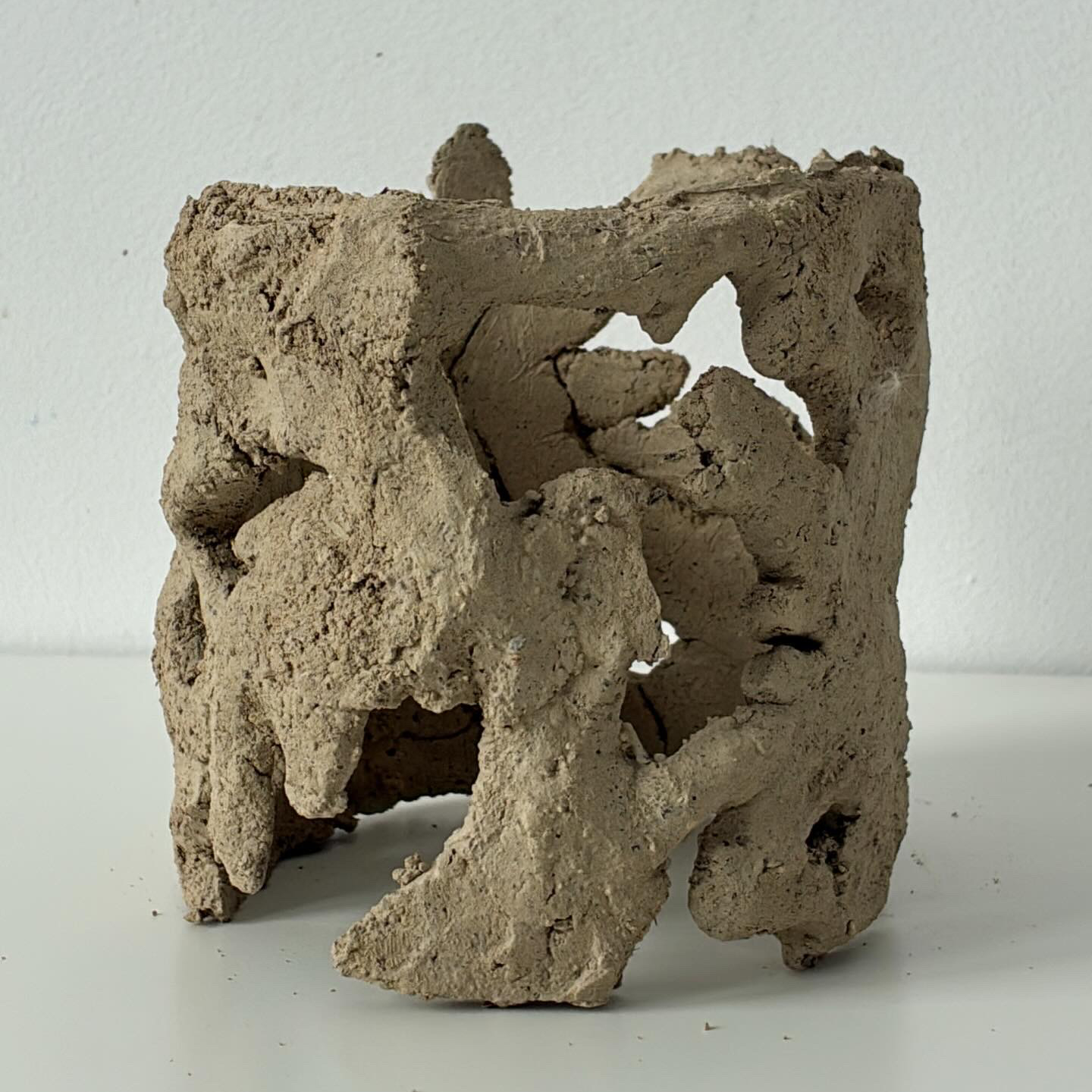
Figure 3 — Cylinder built by hand using coils of earth from an algorithmic pattern. Photograph: Gustavo Assis.
This procedure draws close to ceramic coil building, while sharing affinities with building methods that rely on successive elements, such as certain earth construction techniques.
There is also an analogy with additive manufacturing: the form emerges from the progressive assembly of material, although here the coils were arranged horizontally rather than deposited vertically by a machine.
What I consider most significant in this experience, however, is not the resemblance between procedures.
The material’s resistance to the initial strategy compelled me to rethink the procedure and discover another way of constructing the geometry.
The digital pattern remained a reference, but it ceased to dictate the fabrication process in its entirety. The solution arose from the interaction between the properties of the earth, prior experience with ceramics, and decisions made in the course of making.
Learning Between Code and Gesture
The experiments in PLA and earth began with the same algorithmic geometry, yet they yielded significantly different objects.
The 3D-printed plastic cylinder presented a more regular surface and a tighter geometry. The piece built with earth coils retained irregularities, porosity and the marks of manual work.
These differences do not simply signify greater or lesser fidelity to the original drawing.
They reveal how fabrication processes participate in the constitution of form.
In the PLA model, the slicer introduced support structures necessary for printing. In the earth model, cracking in the slab led to a reformulation of the construction method itself.
In both instances, fabrication conditions redirected the path initially envisioned.
This observation carries implications for the teaching of digital fabrication.
We often learn to use tools with the goal of achieving the closest possible match between the digital model and the produced object. Yet experimentation can also teach us to recognise the discrepancies between what we design and what materials allow us to realise.
Error, in this context, need not be viewed solely as an unwanted defect. It can become an opportunity to observe, rethink and develop alternative procedures.
The three experiences were devised using relatively accessible tools: laser cutting, desktop 3D printing, paper templates and manual earth building.
They do not constitute certified building systems for architectural construction, nor do they replace the technical knowledge required for employing earth materials in building.
Their value lies in opening intermediate stages of learning between digital design and material experimentation, where encountered constraints become part of the educational process itself.
From Code to Earth
Throughout these experiences, I sought to understand how digital fabrication might contribute to learning about earth materials without supplanting direct, bodily contact with them.
The most important outcome was not obtaining a specific geometry, but realising that design can transform in the course of making.
The experience of the cracked slab brought this relationship into sharp relief. The algorithmic drawing offered guidance, but could not foresee all the conditions necessary for construction. It was necessary to rethink the strategy and draw upon knowledge acquired through ceramics to find an alternative path.
I believe this capacity for reformulation is among the most productive aspects of hybrid prototyping.
Digital technology can widen the scope of experimentation, but the knowledge generated during making depends equally on paying heed to material responses.
Between code and earth, therefore, lies not simply a passage from information into form.
There is a field of negotiation between design, tools, matter and gesture, in which the project itself is transformed.
Reference
ROCHA, D.; FARIA, P.; LUCAS, S. S. (2023). Additive Manufacturing of Earth-Based Materials: A Literature Review on Mortar Composition, Extrusion, and Processing Earth. Materials, 17(1), 202. https://doi.org/10.3390/ma17010202
Text adapted from the paper ‘From Code to Earth: Hybrid Prototyping for Earth-Based Construction’, presented at the international conference Earth USA 2026.
← Return to experience «From Code to Earth»
About the Author: Gustavo Assis

Related Posts