
The Humble Origins of Kohiki Ceramics
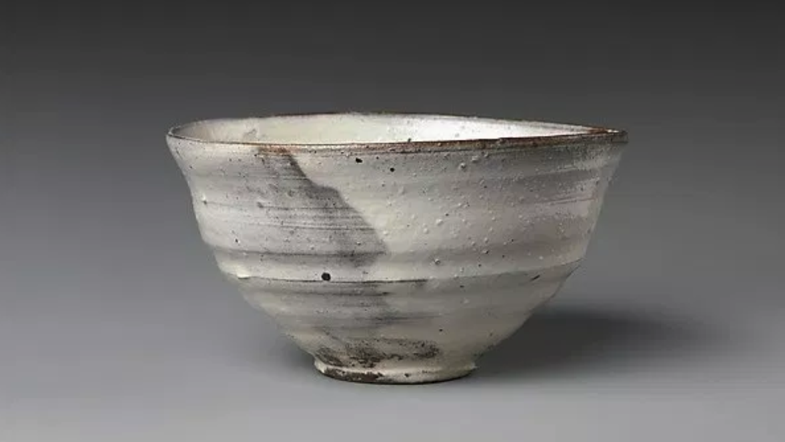
What is Kohiki?
The technique known as Kohiki began between the 15th and 16th centuries. These pieces were originally fired on the Korean peninsula and belong to a family of ceramics with a predominantly white appearance. During the Joseon dynasty (1392–1910), wares decorated mainly with white slip were known collectively as Funseisaki (the Japanese pronunciation), or Buncheong Sagi or Punch’ong Sagi in Korean.
Kohiki was one of the techniques Korean potters used to decorate wares for their domestic market that attracted the attention of Japan’s tea ceremony connoisseurs. Through Korean merchants based in Osaka, and later the Japanese army’s invasion of the Korean peninsula in the late 16th century, pottery regarded as second-rate in Korea came to be highly prized aesthetically in Japan. Kohiki had emerged in Korea to satisfy less wealthy people’s desire for white-looking ceramics, since ordinary people were forbidden to use porcelain. At the end of the invasion, as the Japanese army withdrew from Korea, several Korean potters were brought to Japan, where they helped advance ceramic production. Whether they were abducted or travelled willingly remains a matter of debate. Accounts suggest both possibilities: at least one Korean potter tried to return home, while another became a samurai, reflecting the considerable prestige he attained in Japan.
Alongside the representative Kohiki, among Funseisaki wares we can also mention celadon, in which celadon glaze is applied over white-clay decoration; Sogan Funsei, in which slip of a different colour is inlaid into areas scraped from the white decoration; or Mishima-de, in which parts of the white-clay decoration are removed.
The clay bodies varied, but the most common approach was to coat dark, iron-rich clay with white slip to give the piece a whiter appearance. The type of Funseisaki known as Kohiki gradually ceased to be produced on the Korean peninsula at that time, but today many Kohiki pieces are made, mainly in Korea and Japan.
How It Is Made
In simple terms, a very fluid white slip is prepared and the unfired, leather-hard piece is dipped into it. Kaolin is a common ingredient. Additions such as silica, which reduces excessive shrinkage of the slip layer, and feldspar, which acts as a flux and helps the slip adhere to the clay body, are recommended. The suggested proportions are 70% kaolin, 20% silica and 10% feldspar. Before the other ingredients are added, the white clay, or any other plastic ingredient, is dispersed separately. The remaining ingredients are then added and the mixture passed through a 100-mesh sieve. To improve adhesion and help prevent the ingredients from settling, a little seaweed syrup known as funori is traditionally added to the mixture; methylcellulose can be used instead. Slip is applied in much the same way as glaze: by dipping, brushing, pouring from a cup and other methods.
The Characteristics of Kohiki
It is generally used on pieces made from iron-rich clay, which are coated with white slip. Kohiki usually has white slip over the entire piece, including its base (the kōdai).
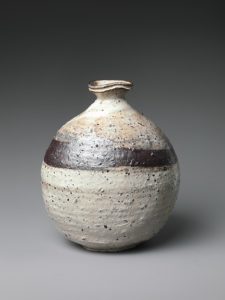
Tsujimura Shirō (Japanese, born 1947). 2000. Kohiki style. Height: 22.6 cm. Metropolitan Museum of Art, New York.
After the dark clay body has been decorated with white slip, a transparent glaze is applied and the piece receives its final firing. The dark, iron-rich clay can be seen showing through the slip.
The tiny cracks in the crazing, air bubbles on the surface (Buku), eruptions caused by small stones (Ishihaze) and tones produced by the interaction between the white slip and dark, iron-rich clay body are all appreciated as part of the piece’s “landscape” (keshiki).
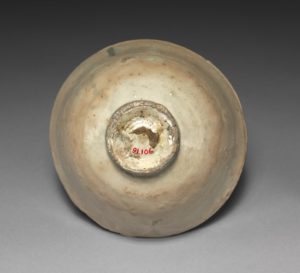
Kohiki ware. 15th–16th century. Korea, Joseon dynasty. Diameter: 17.00 cm; height: 8.30 cm. Cleveland Museum of Art.
The finish of the circular foot gives a strong impression of its traditional form. Where the slip thins, the colour of the iron-rich clay body shows through. Some grey clay is also left exposed around the foot and on the part that touches the ground or tatami (known as tatami-tsuki). Although white slip provides the overall ground, the vessel’s many subtle variations are among the charms of kohiki.
Source:
- 粉引. http://touroji.com/choice/kohiki.html
- Covell, Jon Carter and Alan. The World of Korean Ceramics. Si-sa-yong-o-sa, Inc.
- Wilson, Richard. Inside Japanese Ceramics. Ed. Weatherhill.
About the Author: Gustavo Assis

Related Posts

[…] por vezes aparece na peça). Na garrafa abaixo eu usei a técnica japonesa kohiki (veja sobre ela aqui). Veja como a argila vermelha do terracota ficou cinza. Isso é sinal que houve redução no […]