
Following a Firing in a Noborigama Kiln
Hello!
At the end of June, I had the opportunity to visit the Suenaga e Jardineiro studio near Cunha, in the state of São Paulo, Brazil. The town has become a centre for studio and artistic ceramics, and many artists have chosen to establish their studios there.
The studio is run by potters Kimiko Suenaga, from Tokyo, Japan, and the Brazilian Gilberto Jardineiro. They have developed an almost self-sufficient ceramics production system. Clay comes from local deposits, glazes—including some made with rice-husk and eucalyptus ash—are prepared on site, and firing takes place in a Japanese-style kiln called a noborigama.
The Noborigama Kiln
Nobori comes from the verb noboru, meaning to climb, and kama is Japanese for kiln. It is a climbing kiln with several combustion chambers arranged in steps. These kilns were introduced to Japan in the mid-16th century by Korean potters who settled there, representing a significant advance over the more primitive anagama kilns previously used in the Japanese archipelago. These earlier kilns still coexist with more modern ones today, but the noborigama is a traditional Japanese high-temperature wood-fired kiln that offers greater temperature control and more efficient firing.
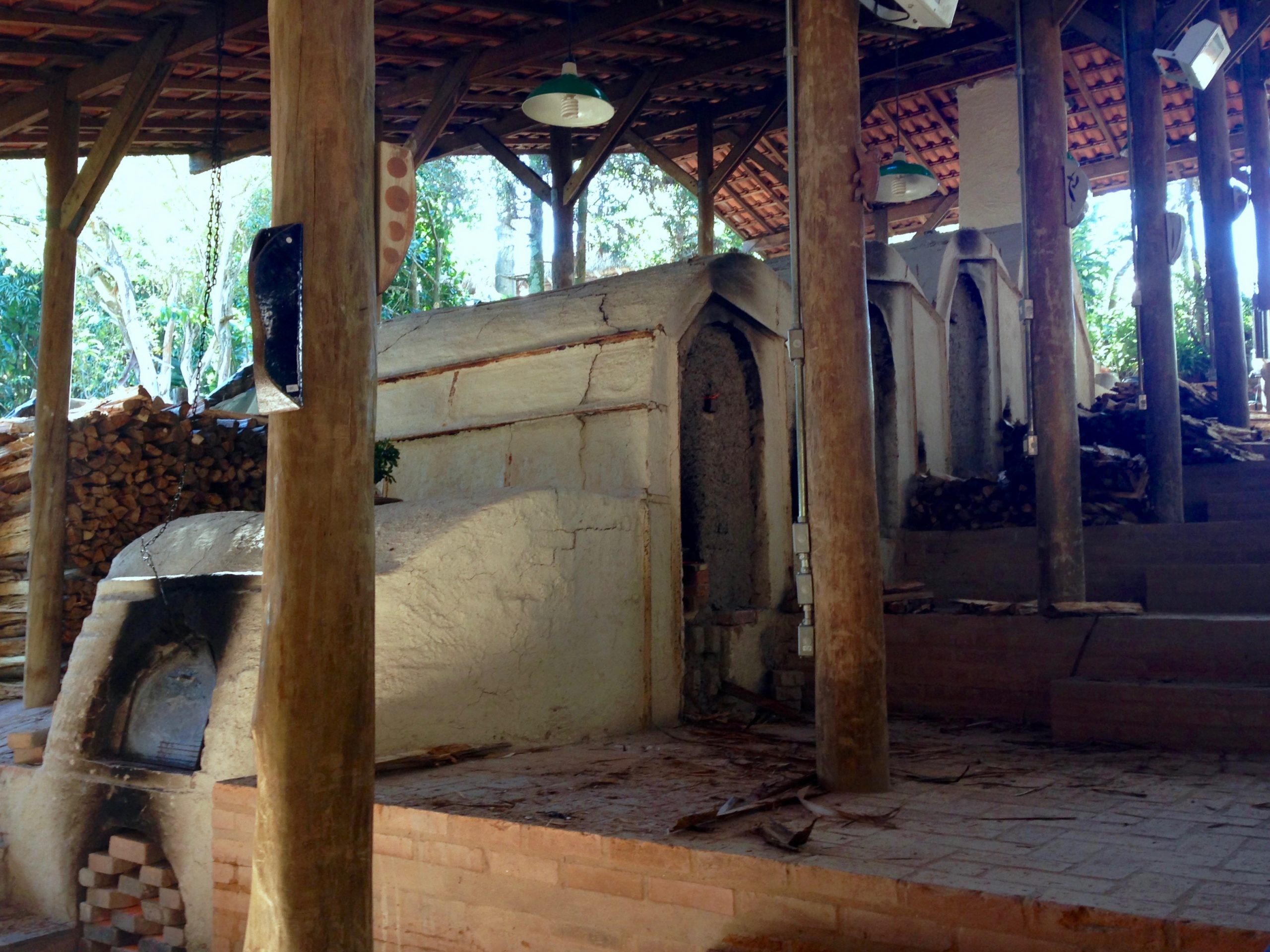
The photograph above, taken at the studio, shows the main firebox at the bottom of the kiln, the four firing chambers that hold the ware, and the chimney at the top. One reason for this kiln’s efficiency is its slope. Hot air rises, and the slope encourages a constant airflow that feeds combustion and heats the chambers. We know that greater airflow makes the firing more powerful, and we can think of these kilns as one large chimney. Their chambers, however, are their distinguishing feature. Within each chamber, the flames are directed upwards, then pass across the shelves holding the ware before leaving through a lower opening at the side into the next chamber. This makes the temperature more uniform throughout each chamber.
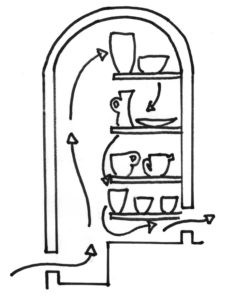
Movement of flames within the chambers of a noborigama kiln
Firing Day
Wood-fired kilns take longer to fire than electric or gas-fired kilns. In the Suenaga e Jardineiro studio’s noborigama, it takes 25 hours for every chamber to reach the desired temperature.
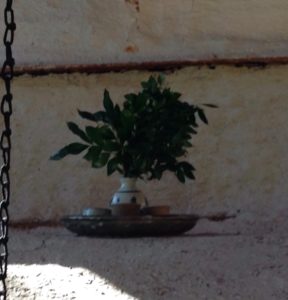
The Japanese tradition of offering sake to the deities before a firing
I arrived at the studio at 9:00 on a beautiful winter morning to follow the noborigama firing. The staff had started the previous day, feeding wood only into the main firebox at the bottom of the kiln. This initial firing warms the chambers slowly, since heating too quickly at the start risks making the pieces explode.
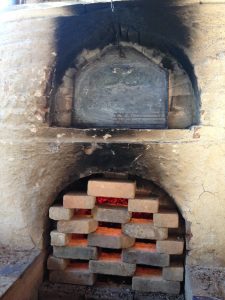
The noborigama kiln’s firebox
At 8:00 the following day, they began stoking the first chamber. As you can see in the photograph below, wood goes into the chamber beside the ware. Care is needed when throwing it in so that it does not strike the pieces stacked alongside. Long and short logs are also selected to distribute heat evenly across the width of the kiln; deciding when and how to stoke them depends on the staff’s skill and experience. The aim at this stage is to fire for 1 to 1½ hours until pyrometric cone 15 bends. Pyrometric cones are made to measure the combined effect of time and temperature. When they bend, they tell the potter that the ware inside has reached the required firing condition. Here, once cone 15 bends in one chamber, firing moves to the next until all the chambers are finished. Cooling must be slow to avoid severe thermal shock. With the firing completed on Tuesday afternoon, the chambers will not be opened until Saturday morning.
-
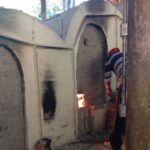
- Firing in the chamber
-
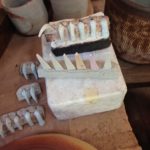
- Pyrometric cones – from 9 to 15
Opening the chambers is an event in its own right. The public is invited, and many people buy the freshly fired pieces. There are also talks about firing and making the ware.
I learnt a great deal during this visit and would like to thank Gilberto and Kimiko for their generosity and warm welcome!
I hope you enjoyed it too ;-)!
Until next time!
Sources:
- 日本美術図解事典. 東京美術.
- Wilson, Richard. Inside Japanese Ceramics. Ed. Weatherhill
About the Author: Gustavo Assis

Related Posts


Muito obrigada pela explicação! O cone 15 é de que temperatura?
Atinge em média 1420 graus C.