
Oxblood Glaze
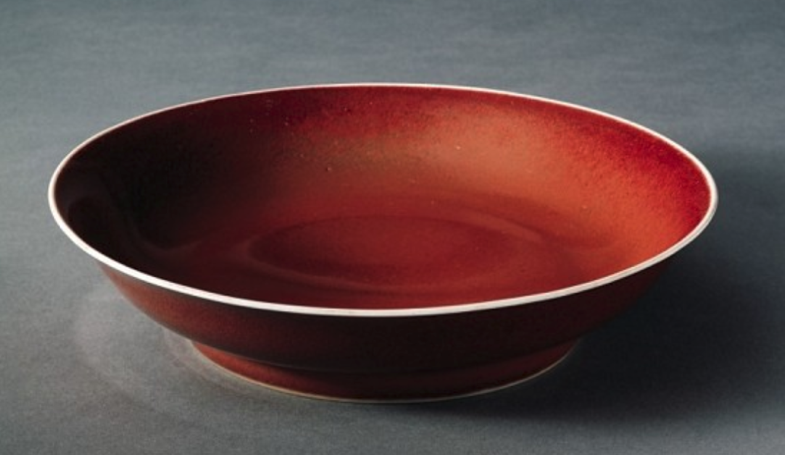
Origins
The method for making oxblood glaze was probably discovered during the Wanli reign (1573–1620) in China. Early examples are extremely rare. Initially very difficult to control, the process was mastered during the reigns of Kanxi (1661–1722) and Qianlong (1736–96), in China’s Qing dynasty.
Composition
Once the technique had been mastered, knowledge of the glaze spread throughout East Asia. In Japan it is called shinsha, meaning cinnabar, or mercury sulphide, a dark-red mineral. Interestingly, the written name combines the characters for dragon and sand. In the West, the glaze became known as sang de boeuf—French for oxblood—and is obtained by adding a small amount of copper (1 to 2%) to a transparent base glaze and reduction firing it. As its name suggests, it has a beautiful blood-red colour. Raw materials cited in this article include cuprous oxide (Cu2O) and copper carbonate. During firing, copper species change according to glaze composition, atmosphere and the thermal cycle. In copper-red glazes studied, colour is associated with copper nanoparticles in the glassy matrix. The process cannot be reduced to the conversion of Cu₂O into CuO under reduction. The ratio of 16 g of carbonate to 10 g of oxide given here is a formulation reference, not a universal equivalence: substitution depends on raw-material composition and actual copper content. The text also mentions 2 to 3% tin oxide as an auxiliary and soda in the feldspar of the transparent glaze. Barium and strontium additions are reported to give favourable colouring results, without guaranteeing the same effect in every composition.
Different Types
Although shinsha is used as a general term, it includes 3 distinct types: Gyūketsukō, Kaensei and Tōkahen. Gyūketsukō is oxblood red; Kaensei has blue-violet markings over red; Tōkahen, or Tōkakō, has pink or faded-red patches.
-
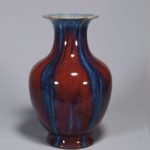
- Kaensei bottle. Qing period, China. Tokyo National Museum.
-
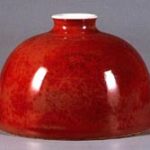
- Kōkahen wine bottle. Qing period, China. Toguri Museum, Japan.
When a piece is entirely red, it is also called Yūrikō. There is also a technique for painting only selected designs or inscriptions: copper-containing pigments are brushed beneath the glaze (shita-e), then covered with a transparent glaze and reduction fired.
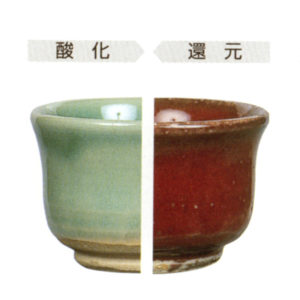
Oxblood glaze in an oxidising atmosphere (left) and a reducing atmosphere (right). Source: Zenbee.com
The Search for the Glaze in Europe
In Europe, several potters succeeded in reproducing this glaze. Theodore Deck, the “father” of French ceramics and director of the renowned Sèvres porcelain manufactory, was well known for his sang de boeuf pieces. His French colleague Ernest Chapel, who began training at Sèvres at the age of 12, likewise devoted his later years to sang de boeuf. In England, Bernard Moore successfully recreated several Chinese glazes. William Howson Taylor, co-founder of Ruskin Pottery, closely guarded his glaze secrets, including sang de boeuf, and destroyed all his glaze formulae before he died.
It is ironic that today anyone can access a recipe for this glaze. Whether we have the skill to produce a good example is another question.
Sources:
- http://www.tokoname.or.jp/glaze/shinsha.htm
- http://global.britannica.com/art/sang-de-boeuf
- http://www.phgmag.com/home/furnishings/201211/sang-de-boeuf-porcelain/
About the Author: Gustavo Assis

Related Posts



Adorei seu post! Muito interessante!
Obrigado Rô! Bjs!
Gustavo,
Procurei até na Wikipedia. Só achei aqui !!!! E qdo abri seu site achei mais … Muito mais!! Parabéns p seu conteúdo!!!!
Também sou arquiteta e estamos sempre querendo nos informar mais, não é?
Thank you
Layde tuono
Obrigado Layde pela leitura! Fico feliz que tenha gostado!