The Role of Fluxes in Glass Melting
Ceramics and glass are among the most fascinating materials, both for their beauty and their technical complexity.
Today, we will explore the fundamental role of fluxes in glass and ceramic glaze production, and understand how they interact with the silica network to transform sand into glass.
The Silica Network: A Rigid, Connected Structure
Silica (SiO₂) forms the basis of most glasses. Its structure consists of a highly connected three-dimensional network, in which each silicon atom is covalently bonded to four oxygen atoms, creating a tetrahedral geometry. This connectivity makes silica extremely stable, but also rigid and difficult to melt.
As a result, pure silicon dioxide has a very high melting point, around 1,710°C, making its industrial processing impractical for many applications. This is where we turn to fluxes.
The Role of Fluxes
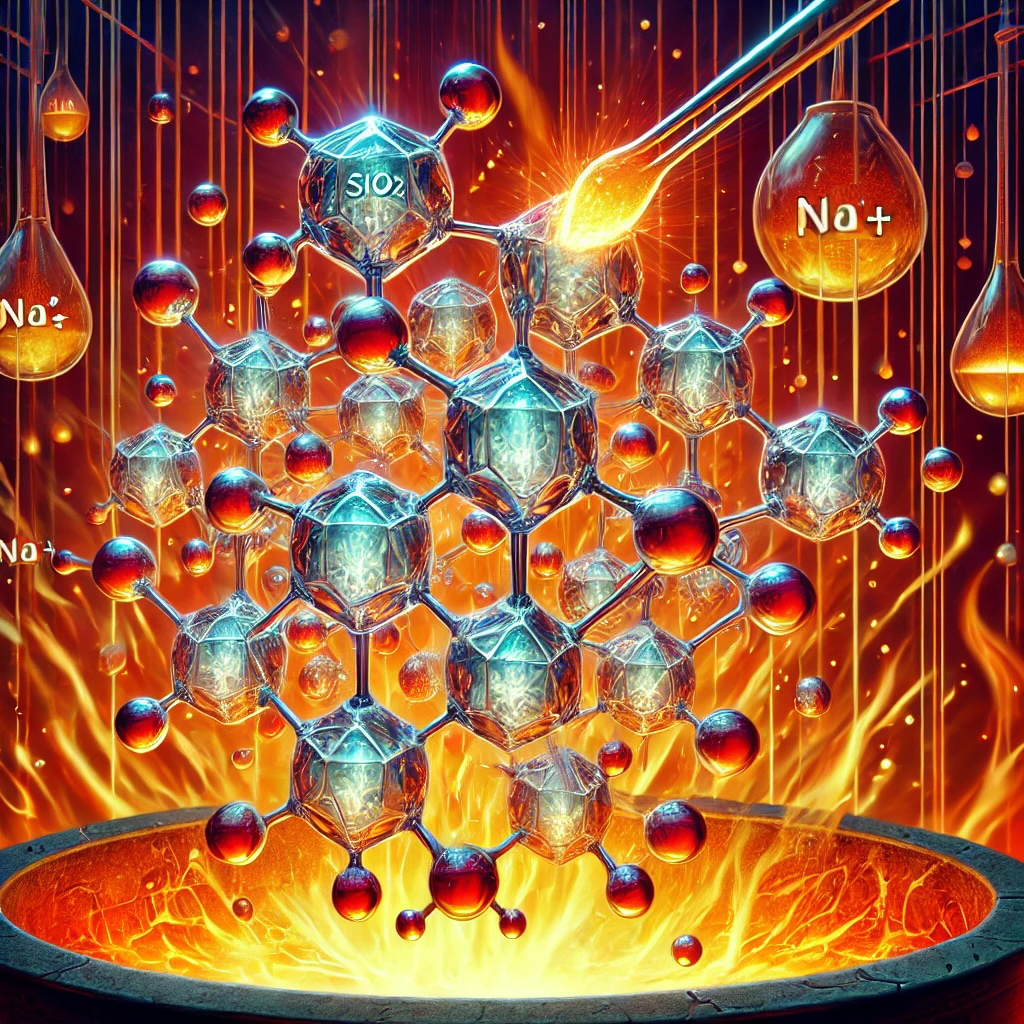
Fluxes, such as alkali oxides (Na₂O, K₂O) or alkaline-earth oxides (CaO, MgO), are added to the batch to lower silica's melting point. They do this by modifying the glass network structure, making it less connected and more fluid.
But how does this happen?
How Do Fluxes Work?
1.Entering the Glass Network:
At high temperatures, flux cations, such as Na⁺ or K⁺, settle into the voids of the amorphous silica network. These spaces exist because of the disordered nature of the glass network, which is more flexible than its crystalline counterpart.
2.Breaking Si-O-Si Bonds:
Once inside the network, the silica structure becomes less able to maintain its bonds amid the intense molecular movement caused by heat, and the cations begin to break Si-O-Si bonds, which underpin silica's connectivity. This creates non-bridging oxygens (non-bridging oxygens or NBOs), oxygen atoms bonded to just one silicon atom rather than two.
These non-bridging oxygens introduce more open regions into the network and increase its mobility.
3.Stabilising the Network with Cations:
After the bonds break, flux cations form ionic bonds with the non-bridging oxygens, neutralising their negative charges and stabilising the new structure. This interaction further reduces the network's rigidity.
4.Lowering the Melting Point:
With fewer Si-O-Si bonds and a more open network, the energy needed to melt the glass is significantly reduced. This explains why glasses containing fluxes can be processed at much lower temperatures.
The Final Result: More Workable Glass
Introducing fluxes into the silica network makes the material:
•Less rigid: Through the creation of non-bridging oxygens and reduced network connectivity.
•More fluid: Making it easier to work at high temperatures.
•Lower-melting: Which is essential for industrial and craft applications.
This process also enables different types of glass to be made, from ordinary soda-lime glass to more specialised glasses with compositions tailored to particular purposes.
Fluxes and Sustainability: The Role of Recycled Glass
Interestingly, recycled glass already contains fluxes within its network, making it easier to melt and process than virgin raw materials. This not only saves energy but also helps conserve natural resources, making recycled glass a sustainable choice for producing new glass.
Conclusion
Fluxes play an essential role in glassmaking by “dismantling” silica's rigid network and creating a more fluid, workable structure. This transformation not only enables large-scale glass production but also opens up possibilities for artists and craftspeople.
If you are passionate about ceramics and glass, understanding materials is the first step towards mastering the art. I hope this post has brought greater clarity and curiosity to the fascinating world of glass chemistry!
If you have questions or would like to discuss the relationship between chemistry and art further, leave a comment! Let us share ideas and build together.
About the Author: Gustavo Assis

Related Posts