Shell Decoration and Glazing
Complete Glaze Coverage
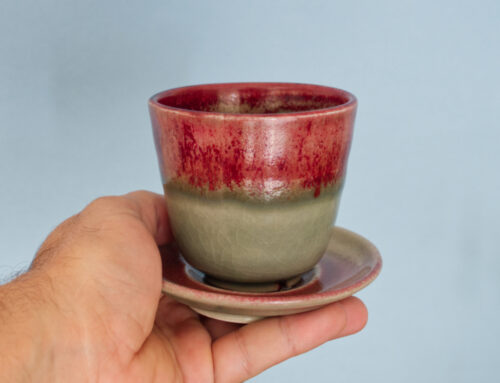
Sō-gusuri is a Japanese expression meaning that a piece is completely covered with glaze. The prefix sō follows the pattern of Japanese words such as sō-ryoku (total strength), sō-gō (synthesis), and means “total” or “all”; while uwagusuri (from which the suffix gusuri comes) means glaze in Japanese. A ceramic piece completely covered with glaze, including its base, is therefore called sō-gusuri.
We can see this technique, for example, where celadon glaze was applied (read more about this glaze here). Considerable effort was made to leave no clay exposed, including where the piece touches its support, an area known in Japanese as tatami-tsuki.
Japanese chawans (ceremonial tea bowls) of the Momoyama period were also intended to capture the symbolic beauty of black and red glazes. These pure colours represented the height of beauty through glaze, and the bowls were completely covered using the sō-gusuri technique.
Me-ato
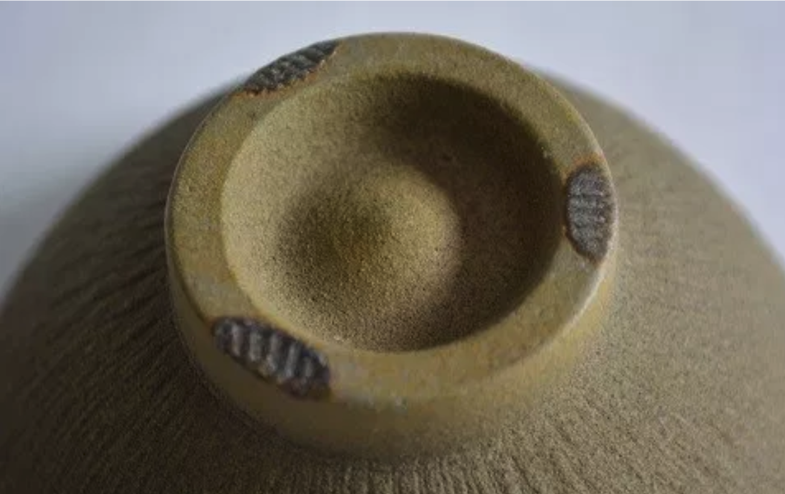
At high temperatures, glaze melts into a glassy substance. As it cools and hardens, it bonds the base of the piece to the kiln shelf. To prevent this, the base is either left unglazed, exposing the “bare” clay (tsuchi-mise), or a solution is devised, such as placing rounded pieces of clay beneath the piece at the tatami-tsuki. As a result, the tatami-tsuki bears the marks of these supports, known in Japanese as me-ato (literally, “eye traces”).
In wood-fired kilns, ash from the burning wood also covers the ware, walls and shelves and vitrifies at high temperature. Over time, supporting surfaces become coated with this natural glaze. Unless the shelves are scraped clean—a laborious task—the pieces will eventually stick to them. Small clay wads are therefore needed beneath the ware even when no glaze has been applied.
Shell Decoration
One of the most interesting ways to prevent a piece from sticking to its supporting surface in the kiln is known in Japanese as kai-metsumi. Shells withstand the kiln’s heat well and leave an interesting pattern on the surface. Some potters therefore replaced the small clay wads with shells. A solution born of necessity became a form of decoration. The most commonly used shells are small bivalves a few centimetres across. The Akagai (red shells) are the best-known examples, including small varieties such as the mollusc known as Shijimi in Japan.
-
- Piece by Lisa Hammond
-
- Shell marks on the base of the piece. Source: touroji.com
The term sō-gusuri is widely used in Japan for chawans and bowl-shaped pieces (wan-nari). There, the base is also an object of appreciation. I hope this text will be useful when you are appreciating or choosing a ceramic piece.
Source:
- http://touroji.com/elementary_knowledge/sougusuritomeato_tuchimise.html
About the Author: Gustavo Assis

Related Posts