
Ash Glazes
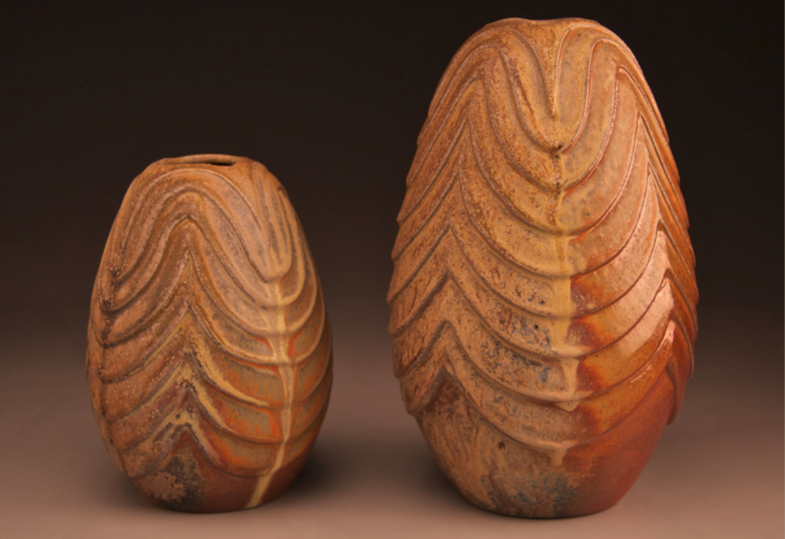
In the heat of a ceramic kiln, many materials burn or melt. Plant ash is one of the most traditional glaze ingredients and is widely used by East Asian potters. Classic glazes such as celadon, chun and tenmoku come to mind. In fact, it is difficult to name an East Asian glaze that does not use ash, or did not use it in its original formulation.
The composition of plant ash can vary with the plant species, its age and even whether it is healthy or diseased. Monocotyledons, such as grasses and rice, are richer in silicon, a refractory and glass-forming element. Dicotyledons contain calcium and magnesium, two fluxing elements.
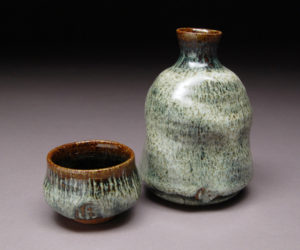
Sake set by Michael Coffee. Unwashed ash glaze. Reduction firing to cone 10.
To prepare ash, the plant material must first be burned. However, only about 1% of the plant mass becomes ash, as much of it is consumed in the fire and releases heat. The non-combustible fraction, including basic minerals, remains as ash. These minerals result from the plant's absorption of the inorganic elements it needs to live. Ash is, so to speak, an extract of the essential elements supplied by the soil.
To use ash as a glaze, it is desirable for the kiln to reach at least cone 10, approximately 1,300°C. Rice ash, which is richer in silicon, requires even higher temperatures. Reduction firing is also particularly suited to ash glazes.
Preparation
Preparation is not complicated, but it takes work. You can burn the wood in a barbecue, if you wish. First scrape and thoroughly clean the inside so that rust does not contaminate the ash with iron. It is also best to burn only one type of wood: this gives you a better chance of obtaining similar results when you repeat the recipe. Burn it slowly to ensure complete combustion. This can take two to three days.
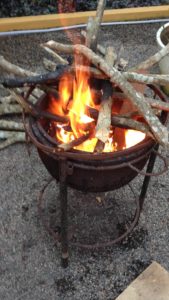
Burning the wood
Once the material has burned completely, separate the ash from charcoal and other impurities using an 80-mesh sieve. Caution: ash contains highly caustic substances that can enter the respiratory system and cause serious irritation. Wear a mask and gloves during this process!
After sieving, you can either wash the ash or use it as it is in a glaze. Washing removes soluble components that can make the glaze run excessively. Put the ash in a bucket, fill it with water and stir thoroughly. The next day, pour off the water and any impurities floating on the surface. The ash should have settled at the bottom. Repeat four or five times, until the water you pour off is clear. Then dry the ash on a plaster slab and store it for use in glazes.
Composition
The next step is to test how the ash you have prepared behaves after firing.
Here are some suggested test recipes from Brian Sutherland's book, Glazes from Natural Sources:
Test 1:
| Feldspar | 50% | 60% | 70% | 80% |
| Ash | 50% | 40% | 30% | 20% |
Test 2:
| Clay | 50% | 60% | 70% | 80% |
| Ash | 50% | 40% | 30% | 20% |
Note: weigh the clay when completely dry.
Conclusion:
Using ash offers potters a way to connect with some of the most basic natural materials. It requires very little processing and gives potters greater control over ceramic production. The variability of the material also offers a wide range of effects to explore.
Sources:
- Forrest, Miranda. The New Ceramics: Natural Glazes, Collecting and Making. University of Pennsylvania.
- Sutherland, Brian. Glazes from Natural Sources. University of Pennsylvania Press.
About the Author: Gustavo Assis

Related Posts
EXCELLENT… CONGRATULATIONS ON SHARING THIS…
Thank you very much, Carlos! I'm glad you enjoyed it!
My grandmother used to do this!!!! My dream is to make ceramic pieces this way, just as my family from Minas Gerais did!??
This technique was once widely used, and it would be wonderful to see more potters using it.
Gustavo,
What interesting information. An easy-to-understand text. I loved it. It already makes me want to experiment.
???
Thank you for reading, Fátima. I'm glad you enjoyed it!
Great, this is the first simple, clear explanation I've found… One question: does this mean ash cannot be used for low-temperature glazing…?
Hello Luiz, I don't think so…
It can if the ash is mixed with 096.
[…] months ago, I wrote about ash glazes, but recently I've had good results in this area and wanted to […]
I'm beginning to explore this territory. Very eager to learn!
Starting my research into natural glazes.
Enjoy your research, Mário! Make the most of this promising field!
I lived in the countryside for many years, where we only burned wood for cooking or for bonfires at the June festivals. Only now have I learned about this use for ash. I liked it.
Thank you for reading, Juraci!
Hi Gustavo, congratulations on the article. I really enjoyed it.
Can natural glazes be fired in an electric kiln?!
Thank you
Hello Juliana, thank you for reading. Ash glazes can indeed be fired in an electric kiln, although the results differ from those of a gas or wood-fired kiln.
I'd like to know whether ash can be mixed with clay to make the piece itself.
Yes, but it would be more interesting to use that mixture to make the glaze.
An excellent explanation. It's hard to find something that explains it so well. Thank you very much and congratulations.
Thank you very much for reading, Eduardo!
Hello Gustavo, congratulations on your work. Your articles are helping me a great deal with my home ceramics adventure.
In another post about glazes, you mentioned boron for firing below cone 6. I'm firing at 1000 degrees. If we replaced the feldspar with boron in the ash glaze, could we fire it at 1000 degrees? What would you recommend? Thank you for your attention.
Gabriel, thank you for reading! Adding boron frits helps considerably with low-temperature firing, but I don't know whether the components of the ash will melt even with added boron. Try several tests with varying amounts of these two ingredients: 90% boron frit + 10% ash … 10% boron frit + 90% ash. Then write to me about the results!
I thought this was really interesting. I'm a potter and would like to learn more about glazes. I've always only bisque-fired my pieces for use as planters. Congratulations, excellent work.
Hello Jorge, I'm glad you enjoyed it. Best wishes!
Hello, I really enjoyed these tips on ash glazes: the author's way of teaching is easy to understand. I can't wait to test what I've learned here. Thank you very much.
Thank you for reading!
Hello, I'd like to know whether clay and ash alone will form a glaze.
And how much of each should I mix?
Hello Antônio. In theory, yes. But you need to test the best proportions of each ingredient and see whether it works in your kiln. Best wishes!
I really enjoyed the tips! I haven't glazed anything yet because I don't know which clay to use or how to reach the melting temperature. This was very helpful, thank you!
I'm glad I could help! Thank you for reading!
Gustavo, to glaze with ash, do you simply spread it over the piece?
Thank you for sharing such valuable knowledge.
Hello Nalme, thank you for reading! You can sprinkle it over the piece or use dipping, with the ash suspended in water.
Very helpful guidance.
Very interesting. I enjoyed your explanation and would like to put it into practice and see the result. Congratulations on the guidance.
I'm glad I could help! Thank you for reading!
Hello, this is the best explanation of ash glazes I've found. Congratulations. I'd like to know whether I can add CMC.
Thank you very much for reading! Yes, you can add CMC.
Excellent!
Do you have any publications? I'd like to buy them.
Another question: can I add stains?
Hello Edna, thank you for reading! I don't have any publications. You can add inorganic stains or oxides for colour.
Congratulations… I loved how clearly you explain things… I'd like to know what kind of container I can use to calcine the ash… Can the container be glazed or not??? And would 800 in an electric kiln be enough?
Thank you
Hello Dayse! Thank you for reading! I think it would be better to use an unglazed crucible. Avoid high temperatures, as the ash will melt: remember that it is full of fluxes! You can use an electric kiln, and I think 800 degrees is more than enough to calcine the material. I hope this helps!
Your blog, with these accounts of your artistic research, is a national treasure. I'm loving reading it and putting things into practice here in my simple studio in the far south of Bahia.
Thank you
Hello André, thank you very much for reading! Best wishes!
I'm going to try it. Thank you.
Excellent explanation. I was already researching ash glazes and can't wait to test them and make wonderful pieces. Thank you!
Thank you very much for reading!
I loved the article!! I'm new to ceramics and am now beginning to study glazes. I really enjoyed this information. Thank you for sharing!!
Thank you for reading, Valéria! Good luck with your studies!
Warm greetings
Gustavo, what advice do you have for building a high-temperature gas kiln?
Thank you very much in advance.
Best wishes!!
Hello, can ash-based glazes be used in a high-temperature electric kiln?
Thank you!
Hello Leny, thank you for reading! Yes, they can! Best wishes!
Hello Gustavo! I've been researching the use of ash in glazing for some time, but thought it was only used in raku firing. Your post was very enlightening. Thank you.
Thank you for your comment and for reading.
Congratulations!
It's very interesting to read your texts.
I'm just starting out in ceramics and am curious about the behaviour of Pascoal's tobacco clay.
I bisque-fire at 950 degrees in an electric kiln and the pieces come out normally. When I glaze-fire at 1220, blisters appear.
I wondered whether there might be too much iron in the body or some reaction occurring. I use Pris Spaluto glaze.
Thank you
Hello Rita, I recommend testing the clay without glaze to observe its behaviour. If it still blisters without glaze, it would be a good idea to contact the clay manufacturer. I hope this helps.
Hello Gustavo!
I'm just entering the world of potters and studio ceramics. I'm loving it! It's wonderful! I live in Alcinópolis, Mato Grosso do Sul. As it's in the countryside and I also have a small rural property, I'd like to make my own glazes and improve my ash glazes.
I really enjoyed this content. It will help me a lot.
Thank you very much for reading!
Hello Gustavo, thank you for your posts!
Can these ash glazes be used on functional ware? Are there any exceptions?
Thank you
Yes, they can, with no exceptions.
Hi Gustavo, congratulations on the article. It's very valuable for my research.
I'd like to ask whether natural glazes can be fired in an electric kiln and, if so, whether the ideal temperature would be the same as you mentioned: between 1300°C and 1400°C for silicon-rich ash. I'd also like to know whether the ash melts in the kiln like formulated glazes, and whether it could cover the whole piece without damaging it. Could you offer any guidance?
Thank you
Hello Aléxia, it depends very much on the composition of your ash. Silicon-rich ash has a higher melting temperature. You will therefore need to combine it with other raw materials to adjust viscosity, melting point and so on. Your clay also contains elements similar to those in the glaze, such as Si, Al, Na and Ca, so they are chemically compatible and there is no risk of damaging the piece provided, as I said, that the final formula is adjusted.
Hi Gustavo, I've been doing some very interesting experiments with ash and feldspar. I've never tried clay: what type should I use to experiment?
Thank you.
Hello Lucia, try low-iron clays first, as iron can considerably change the appearance of the glaze. Use paler clays. Over time, start adding terracotta and other more strongly coloured clays. Enjoy your tests!