
Glaze Theory – Part III
Hello everyone! Continuing the glaze series, this week I will discuss glazes’ physical and chemical characteristics and explain how to calculate the Seger unity molecular formula.
The Nature of Glass
We have seen that a glaze is composed mainly of glass formers, which produce the glassy surface of ceramics. Glass is an amorphous solid: it lacks the long-range periodic arrangement characteristic of crystals. On heating, its behaviour changes as it passes through the glass-transition region.
Solids have highly organised structures. Crystals, such as salt, contain millions of aligned atoms, and their structure is predictable. Glass lacks this organisation, but is not as disordered as a liquid.
Below we can compare the molecular arrangement of silicon oxide in its crystalline state, on the left, and glassy state, on the right.
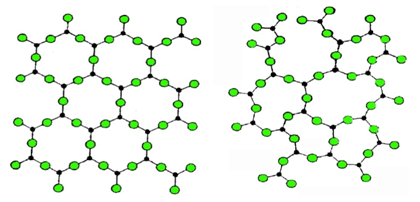
Glass has a degree of organisation, but it does not repeat throughout the network. When glass forms, the glass former, usually silica, is cooled rapidly from its liquid state without solidifying below its melting point. At this stage, it is a supercooled liquid, intermediate between liquid and glass. Further cooling below the glass-transition temperature produces an amorphous solid. Beyond this point, the atoms are almost immobile and unable to organise into crystalline structures: the material is now glass.
Because glass is molecularly disordered, its atoms can still flow like a liquid. Mathematical models, however, predict that a substantial change in its shape from this molecular flow would require longer than the age of the universe.
Fluxes
In ordinary glazes, flux oxides account for a smaller proportion than silica, the glass former, and Al2O3, the stabiliser. At high temperatures (1,300º C), a glaze contains around 18% flux. At mid-fire temperatures (1,180º C), it contains 22%, while low-fire glazes may contain up to 30%, including the glass former boron.
Each flux also has particular melting and volatilisation temperatures, making it more suitable for certain firing ranges. See the table below:

But how does a flux lower a glaze’s melting temperature? Let us look at that next.
Eutectic Mixtures
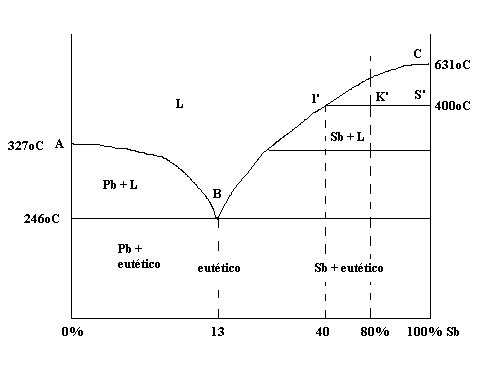
Combining fluxes and glass formers can lower the melting temperature of a mixture. A eutectic composition, however, is a specific condition within a system: in a eutectic reaction, a liquid transforms at a defined temperature into two or more solid phases, or those phases transform into liquid in the reverse direction. Not every mixture that melts below its components is a eutectic composition.
From the previous post, we know that most fluxes are alkali and alkaline-earth metals. They tend to donate electrons to become more stable, usually to oxygen, an electron-accepting element on the opposite side of the periodic table. When dissolved in silica, a weak acid, the alkaline constituents become cations, or positively charged atoms, while oxygen becomes an anion, carrying a negative charge. The doubly negative oxygen anion has a strong affinity for bonding and breaks an oxygen bond in the silica molecule, incorporating itself with a negative charge. Breaking the network into shorter chains makes the melt more fluid and lowers its melting point. Taking calcium oxide as the flux, we have:

Flux constituents also enter the silica molecular chains, giving the mixture greater flexibility, or remain between them as impurities that hinder crystallisation.
Stabiliser
To restrain excessive flow, we make the glaze more viscous. Aluminium oxide joins loose silica chains into a cohesive molecular network, making it an important glaze stabiliser.

The Seger Unity Molecular Formula
Now that we understand more about glaze chemistry, I will introduce a concept developed by the German Herman A. Seger in the late 19th century. Seger also developed numbered cones to measure heatwork in kilns, among other achievements. He classified glaze components as fluxes, glass formers and stabilisers. His unity molecular formula expresses the relationship between the numbers of molecules in these three categories, making glaze analysis easier.
The formula can tell us, for example, whether a glaze has enough silica to form glass or contains too much flux. In the next post, I will discuss the limits that make a good functional glaze, but first we need to understand this calculation.
Computer programs now calculate the Seger formula automatically from the raw materials and their quantities, making the process much more practical. For anyone wanting to understand the calculation itself, here is an example:
Suppose we are working with this glaze recipe:
| Raw material | Quantity |
| Nepheline Syenite | 40 |
| Calcium Carbonate | 20 |
| Silica (Quartz) | 30 |
| Kaolin | 10 |
| Total | 100 |
First, obtain the molecular masses of the principal oxides; Wikipedia provides these data.
| SiO₂ | Al2O3 | Na2O | K2O | MgO | CaO | Fe2O3 | TiO2 |
| 60,09 | 101,96 | 61,98 | 94,20 | 40,31 | 56,08 | 159,70 | 80,90 |
Next, obtain the chemical analysis of each raw material. Glazy.org provides this information free of charge.
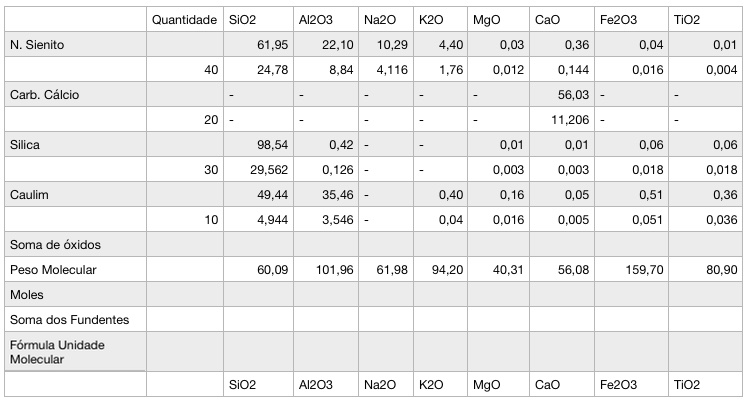
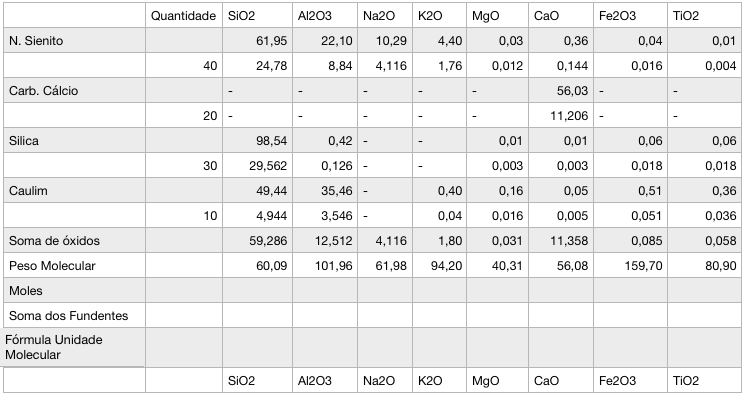
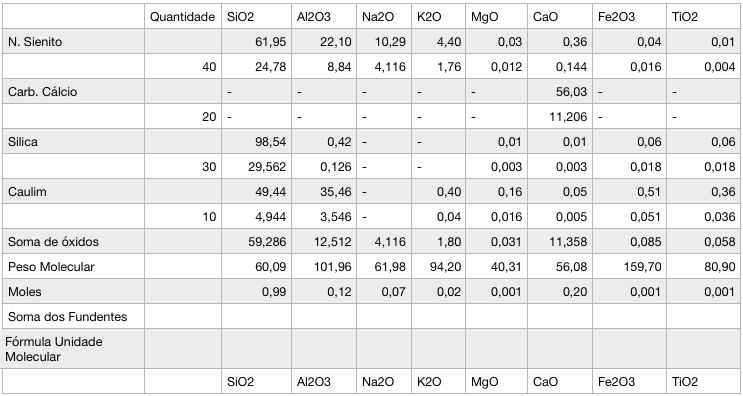
To simplify the calculation, I made a table of the raw materials and their oxide proportions: English key to the labels in the original table images: Quantidade = Quantity; N. Sienito = Nepheline syenite; Calc. Cálcio = Calcium carbonate; Sílica = Silica; Caolim = Kaolin; Soma de Óxidos = Sum of oxides; Peso Molecular = Molecular weight; Mols = Moles; Soma dos Fundentes = Sum of fluxes; Fórmula Unidade Molecular = Unity molecular formula.
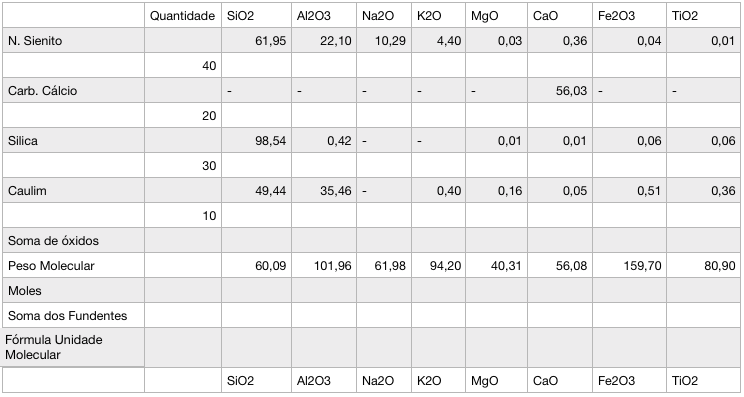
Step 1: Calculate each oxide’s contribution from the quantity of raw material. Here, nepheline syenite accounts for 40 out of 100, or 0.4 of the total. Multiply 0.4 by the oxide quantity. For silica, the calculation is 0.4 x 61.95 = 24.78.
Repeat this for every raw material to obtain the following table:
Step 2: Add together the contributions of each oxide from all the raw materials.
Step 3: Divide each oxide total by its molecular weight to obtain proportions based on the numbers of molecules. In chemical reactions, the number of particles matters: for example, 10g contains more lithium atoms than lead atoms.
Step 4: Add the moles of fluxes (Na, K, Mg and Ca).
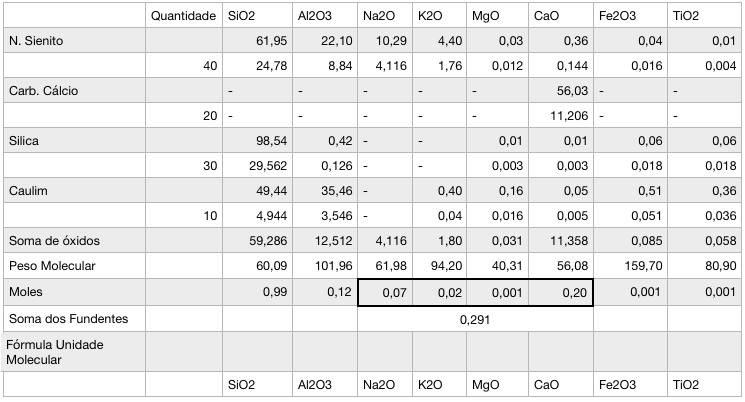
Step 5: Divide the moles of each oxide by the total moles of fluxes.
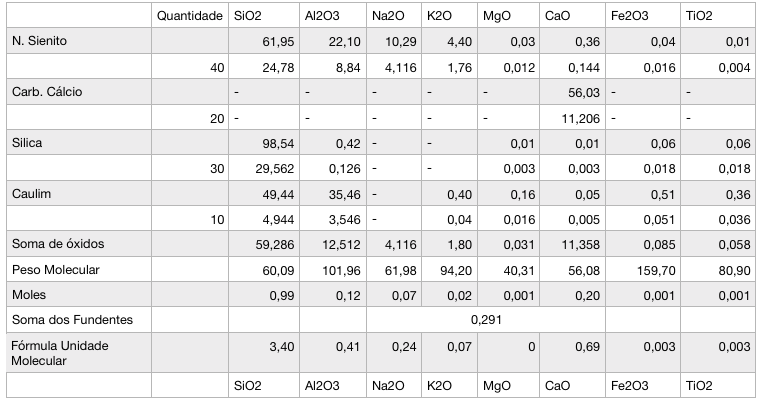
The final result appears in the last row. We have expressed each oxide in molecular terms and related it to the fluxes, establishing a standard in which the fluxes sum to unity. This allows much more comprehensive glaze analysis simply by looking at its Seger formula!
In the next post, you will learn how to use this knowledge to predict glaze behaviour.
Until then!
Sources:
- https://www.scientificamerican.com/article/fact-fiction-glass-liquid/. Scientific American.
- digitalfire.com. Digital Fire.
- Bezerra Brandão, Bráulio. Mechanical Engineering Course. http://www.ebah.com.br/
- Donald Sadoway, 3.091SC Introduction to Solid State Chemistry, Fall 2010 (MIT Courseware). http://ocw.mit.edu (accessed 7/8/2018). Creative Commons Attribution-Noncommercial-Share Alike licence.
- How to Calculate the Unity Molecular Formula. Ceramics Material Workshop. http://www.youtube.com/watch?v=HyLjAg1_8_4 (accessed 8/8/2018). YouTube.
About the Author: Gustavo Assis

Related Posts

Muito bom, obrigada
Thank you very much for reading!
Grato pelo texto Gustavo!!
Obrigado Paulo pela leitura!
Estava procurando uma explicação sobre fórmula de Seger e não encontrei nada como seu post!!! Sensacional sua explicação, e com exemplos! Muito obrigada
Obrigado Elaine pela leitura.
Maravilhosa sua explicação sobre os esmaltes,vou guardar como uma pérola…gratidão
Thank you very much for reading!
Obrigada! Material muito rico.
Thank you very much!
Obrigada pela explicação
Olá Vilma! Obrigado pela leitura!
Hola! Aprendí a hacer los cálculos en un curso pero no sabía que existían programas7que lo hacían directamente, podrías decirle él nombre de alguno?? Un saludo, me encantaron todas las entradas sobre este tema.
Olá Lucia. Obrigado pela leitura. Quanto aos programas, existe o Glazy (em glazy.org), que é gratuito. Espero que seja util!