
Ceramics of China’s Song Dynasty – Part II
Hello!
In the previous post I introduced Song ceramics from northern China. Today, I will show some representative examples from southern China.
Introduction
Famous kilns became established in southern China during the Song dynasty. Jingdezhen’s great porcelain-making centre was one example. The map shows the locations
of the principal Song-dynasty kilns in southern China.
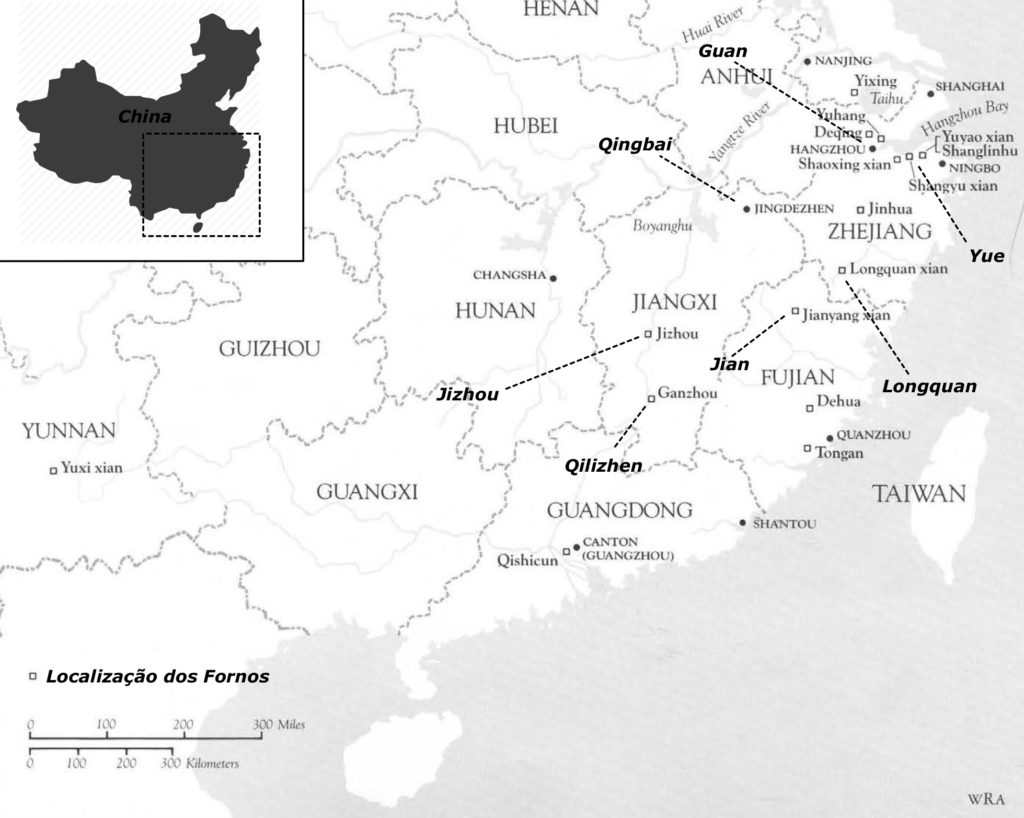
Map of the principal Song-dynasty kilns in southern China. Source: A Handbook of Chinese Ceramics.
Song-Dynasty Kilns in Southern China
Yue Ware
Yue wares have a long history. They were precursors of celadon and strongly influenced Korean potters during the Goryeo period (918–1392). However, sometime in the late 11th or 12th century, the long and distinguished tradition of the Yue kilns in northern Zhejiang came to an end. Their prestige at court declined as wares from southern Zhejiang became more highly valued. The Yue kilns lay south of present-day Shanghai, in the Yangtze River delta.
Longquan Ware of the Northern Song Dynasty
In 2009, Longquan celadon was inscribed on UNESCO’s Representative List of the Intangible Cultural Heritage of Humanity. These kilns played an important part in China’s celadon production from the beginning of Northern Song to the middle of the Ming dynasty (1368–1644). They are located in southern Zhejiang Province, where recent investigations have identified hundreds of kilns producing these celadons. The greatest concentration was between the Dayao and Jincun kilns in Longquan County (see map).
Under the more direct influence of the Southern Song court, Longquan ware became more refined. Glaze studies show that earlier Northern Song examples had a high lime content. During Southern Song, they developed towards slightly less lime and a greater alkali-lime component. These glazes were also applied and fired repeatedly until the desired depth was achieved.
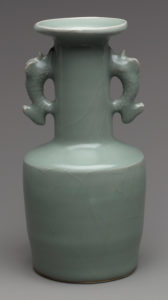
Southern Song dynasty, China. Longquan ware. Height: 17.1 cm. Metropolitan Museum of Art, New York.
The Japanese were among the greatest admirers of Longquan ware and classified the finest examples with the word “kinuta”, meaning a wooden mallet formerly used to smooth cloth. The name supposedly reflects the resemblance between this shape and an example with an incomparable blue-green colour.
Guan Ware
Guan literally means “official”. Certain Ru, Jun and even Ding wares could be considered official in a broad sense because they were intended for the court. More strictly, however, the term applies to wares produced by kilns administered by the imperial government, which began during Southern Song. These Guan kilns were based in the imperial capital, Lin’an, now Hangzhou. During this period, forming techniques became so refined that the clay walls could be thinner than the glaze coating.
Qingbai
There is some debate about the classification of Qingbai wares, which can overlap with the celadon family. Generally, however, Qingbai pieces have a thin, transparent glaze with a slight blue tinge, becoming more intensely coloured in recessed or carved decoration. The best examples have white, translucent, fine bodies. Celadon pieces, by contrast, have thicker clay bodies and deeper glazes tending towards green. Although Qingbai has been reported in northern China, it is essentially native to the south. Jiangxi Province was its largest producer, and kilns around Jingdezhen probably accounted for the greatest volume and finest quality.
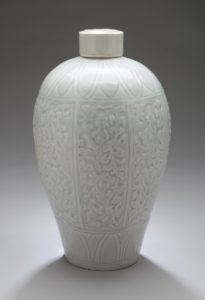
Covered vase with a plum-blossom design (meiping) and lotus details. Qingbai ware, Southern Song dynasty, China.
Jizhou Ware
White wares were produced in both northern and southern China during the Song dynasty. Some examples found at the Jizhou kiln complexes,
in Jiangxi Province, show the influence of northern kiln materials, particularly classic Ding porcelain from Hebei. Besides white wares, Jizhou kilns produced many tea bowls with a more rustic but equally captivating character. Glazes ranged from dark chocolate to yellowish brown. One of several interesting decorative methods involved placing leaves against this
dark ground to create yellow or creamy-beige impressions. Paper-cut patterns were probably also used as masks when applying the glaze.
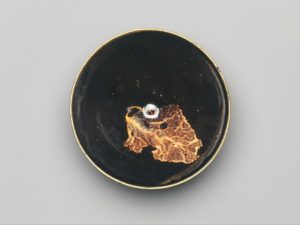
The Metropolitan Museum of Art, New York.
Another frequent effect is “tortoiseshell” marking, in which a dark-brown glaze with irregular yellow or cream splashes is applied to the piece.
Qilizhen Ware
Other southern Chinese kiln complexes also produced dark high-fired wares, often alongside celadon, white and Qingbai glazes. One of the most
interesting examples is the Qilizhen kiln group near Ganzhou, Jiangxi Province.
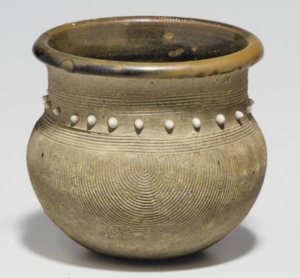
High-fired ware with designs incised into the clay. Height:
10.2 cm. Southern Song–Yuan dynasty. Possibly Ganzhou ware,
China.
Jian Ware
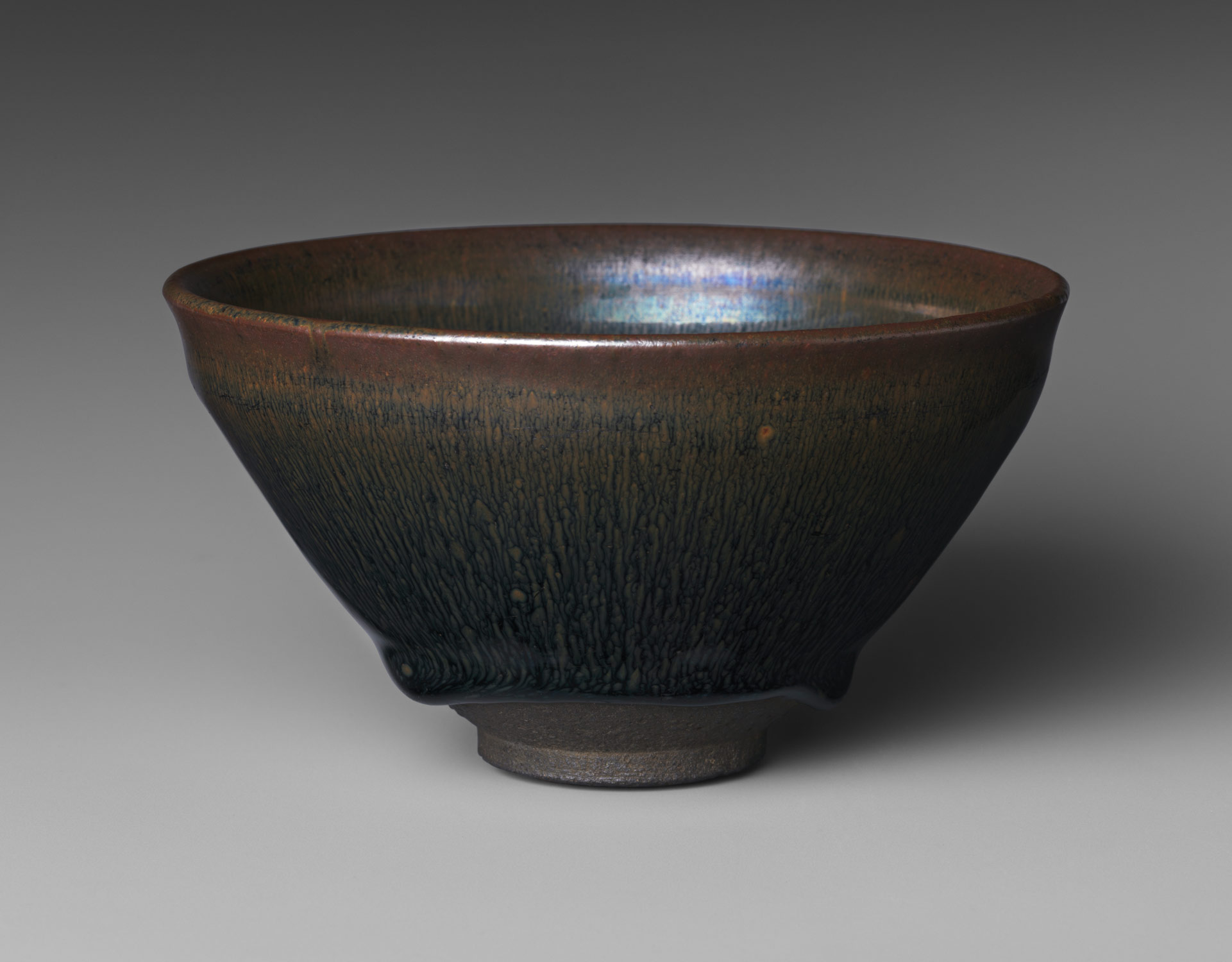
Many dark-glazed wares were produced in southern China during the Song dynasty. Perhaps the most characteristic are the tea bowls made at the Jian kilns in Fujian Province. Their glossy glaze was brownish black or bluish black, usually with flowing brown streaks resembling hare’s fur. Rarer pieces had spots resembling oil droplets. The glaze was very thick and can be seen running down a bowl like a frozen drop, preserving a moment of its time in the kiln. A popular name for these dark-glazed wares is tenmoku, the Japanese pronunciation of Tianmu, a mountain in northern Zhejiang Province, China. According to tradition, the mountain housed a Buddhist temple frequently visited by Japanese monks, who took tea bowls back to Japan, where they were highly appreciated.
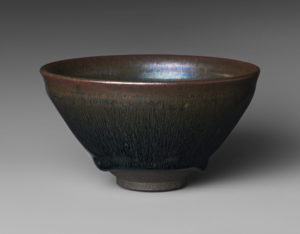
Southern Song dynasty, China. Jian ware with a “hare’s-fur” glaze. Height: 7 cm;
diameter: 12.7 cm. Metropolitan Museum of Art, New York.
Blue-and-White Porcelain
Studies indicate that Song-dynasty blue-and-white porcelain forms a link between earlier Tang examples and the celebrated porcelain of the later Ming dynasty. Alongside the influential ceramic families already associated with Song, we may therefore include one of China’s most famous products as having a lineage in the Song period.
Sources:
- Velenstein, Suzanne G. A Handbook of Chinese Ceramics. The Metropolitan Museum of Art.
- Chinese Ceramics. China International Press
- Nilsson, Jan-Erik. Antique Chinese and Japanese Porcelain Collectors’ Help and Info Page. www.gotheborg.com
- Relationship between Celadon, Qingbai and White wares. www.koh-antique.com/article/qingbaiceladon.htm
About the Author: Gustavo Assis

Related Posts

Boa tarde Gustavo
Somos um casal de ceramistas, sendo minha esposa artista plástica, iniciando trabalho com cerâmica na faculdade, e eu médico, me apaixonando pela cerâmica há 3 anos aproximadamente.
Foi uma grande e boa surpresa encontrar o seu site, pois como deves bem saber, é difícil encontrar bons locais de aprendizado em cerâmica pela internet oriundos do Brasil.
Fazemos cerâmica utilitária e peças artísticas (minha esposa) no interior do RS, utilizando queima a gás há dois anos aproximadamente, com esmaltes utilitários. Temos também grande interesse nos esmaltes Chineses e Japoneses, o que me chamou a atenção no teu site.
Juntamos uma extensa bibliografia sobre as várias fases da produção cerâmica, normalmente americana, e algumas japonesas. Temos amizade com um casal de ceramistas japoneses (ele, ela nissei tendo estudado cerâmica por 8 anos no Japão) que muito nos inspiram e estimulam neste árduo e longo aprendizado.
Vou seguir acompanhando teus artigos e resultados com muito entusiasmo.
Grande abraço
Flávio e Gabriele Girardello
(Instagram gabiegirardello)
Olá Flávio, obrigado pela leitura. Sua mensagem me motiva a sempre pensar em temas interessantes para postar no site. Obrigado!