Japanese Bizen Ceramics
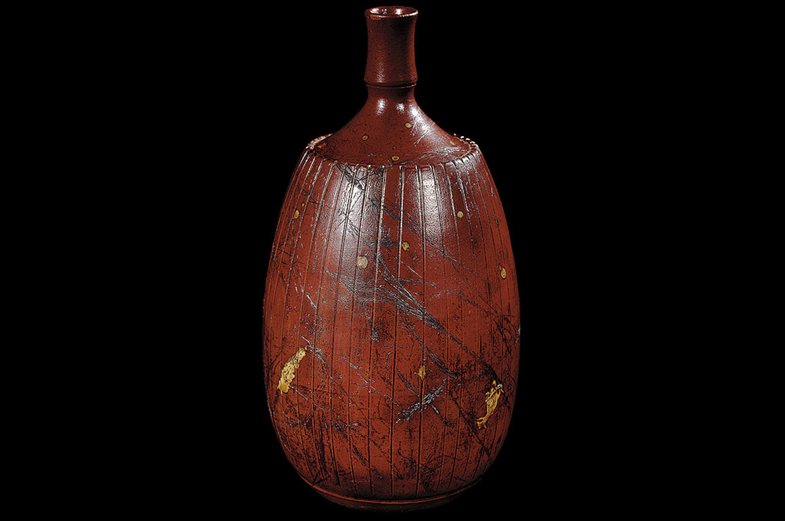
Hello!
Last week, we looked at the elegance of ceramics from China’s Song dynasty. Today, we will explore the origins of the strength of Japanese Bizen ware.
Introduction
Bizen ware traces its lineage to high-fired Sue ware, which began in the Kofun period (3rd–7th centuries CE). In the Middle Ages, Bizen potters produced large quantities of mortars (suribachi) and jars. Together with Tokoname ware, they divided Japan’s ceramic production into two spheres: Tokoname was influential in northeastern Japan, while Bizen predominated in the southwest.
During the Muromachi period (1336–1573), these everyday wares were adopted for the tea ceremony. From the Momoyama period (1573–1615), distinctive pieces were made specifically for tea use.
Bizen ware is produced in the southwestern part of Japan’s main island (Honshū), in Okayama Prefecture (see map).
Materials and Firing
These ceramics have a vigorous style and a simplicity of materials and methods. With no applied glaze, their character comes directly from the flames and clay. Bizen clay is dug from 1 to 3 metres below the region’s rice fields. Although very plastic and easy to shape, it contains a high proportion of iron (1–3%) and has considerable shrinkage, making it unsuitable for glazing. It also contains much organic matter, which can cause cracking and bloating if a conventional firing schedule is used.
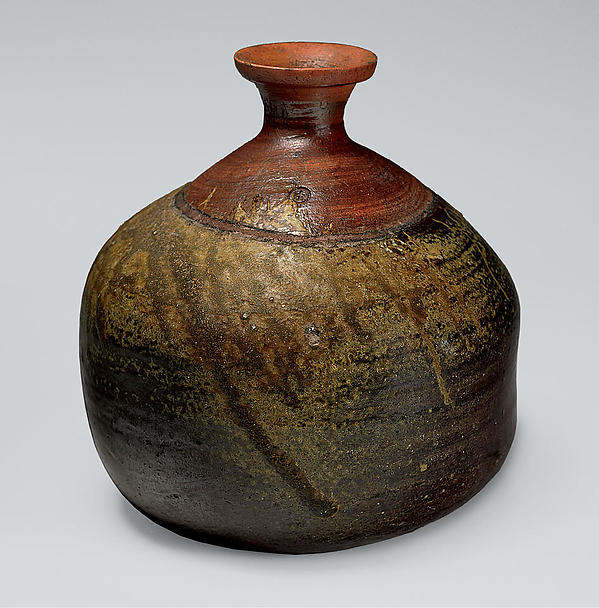
As a solution, Bizen potters stack the pieces and fire them unglazed over a long period. Their position in the kiln determines the effects they acquire. The changes that occur to a piece inside the kiln are known in Japanese as Yōhen.
Characteristics of Bizen Ware
Goma (Sesame)
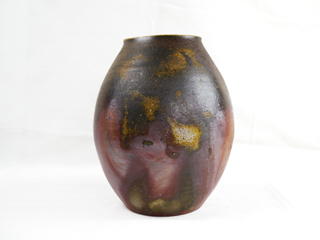
Some Bizen pieces develop adhering patches that resemble sesame meal.
During firing, ash falls onto the pieces. The force of the pine-wood flames and the high kiln temperature cause it to vitrify, forming a natural glaze.
Depending on their position in the kiln, some surfaces receive heavy ash deposits. This ash melts, forming streaks or running down the piece (known in Japanese as Tamadare “hanging jewels”, or Nagare-goma “running sesame”).
The colours vary and may be white, yellow or blue.
Sangiri
This is a change in colour ranging from black to ash blue-grey.
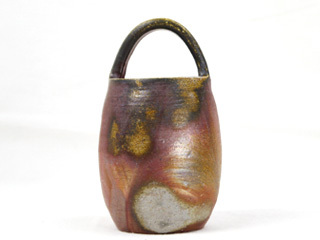
When poor air circulation changes the firing atmosphere (Ibushi-yaki), making it reducing, the fuel turns to ash that covers the pottery.
Generally, the areas directly exposed to the flames become reddish brown, those covered in ash become black, and the areas between them take on an ash blue-grey colour.
In older kilns, crossbars known in Japanese as san were installed inside. Pieces fired beneath them developed this appearance, hence the name Sangiri (literally, the division at the crossbar).
Hidasuki
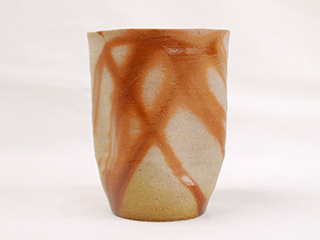
Hidasuki describes brown, light-brown or red bands on a piece. Hi means fire, and tasuki is a cord used to tie back kimono sleeves.
Straw is wrapped around the unfired piece, which is then placed inside a protective container (saya) that shields it from direct flame. After firing, the piece retains a light-brown colour similar to its unfired state, while the areas that touched the straw become scarlet.
The appearance of hidasuki results from reactions involving the potassium in the straw and the iron and other constituents of the clay.
Originally, straw was wrapped around pieces to prevent them sticking together when stacked in the kiln. This appearance was a result of that practical measure.
Botamochi
Botamochi is a rice cake coated with sweet bean paste. The name refers to the circular shape left on the fired piece.
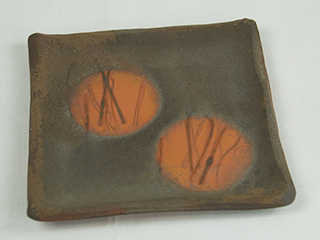
This effect is achieved by placing pieces of clay or other round objects on top of the piece.
As with hidasuki, botamochi originated from stacking pieces.
Ao-Bizen (Blue Bizen)
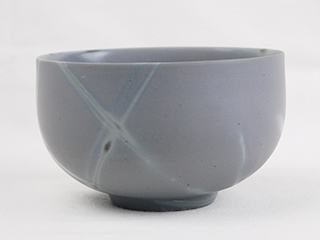
Inside the kiln, when pieces are placed in areas without oxygen, chemical reactions remove oxygen from the piece. Strong reduction during firing produces a vivid blue-grey colour in the pottery.
The less oxygen there is, the closer the pottery’s colour is to blue.
Even with careful planning, there is no guarantee of producing Ao-Bizen pieces. Reducing areas within the kiln are very limited, so this type of pottery is rare.
Conclusion
Bizen ware can be understood as the result of its particular materials and production processes. Over centuries, potters adapted their techniques to the nature of the clay and firing. At first glance, the pieces might seem to emerge from the kiln through random or uncontrolled firing effects, but that is not quite the case.
The conception of the pottery is deliberate and intentional. Drawing on experience, the artist shapes a specific form and places it in a particular position in the kiln, actively participating in the creative process from throwing to firing. Yet even with great care and experience, much can go wrong during firing, which may take place only once or twice a year. A great deal is at stake, so extensive planning goes into the finished work.
When a piece leaves the kiln, it is possible to imagine what happened to it and reconstruct the processes it underwent. This may be one reason why it has so many admirers in Japan and abroad.
Sources:
- 日本美術図解事典. 東京美術.
- 備前焼じゃ. www.bizenyakija.com
- Wilson, Richard. Inside Japanese Ceramics. Ed. Weatherhill
About the Author: Gustavo Assis

Related Posts