
Substituting Raw Materials in Glaze Formulation
Hello everyone!
Introduction
Imagine finding a great glaze recipe online and wanting to test it in your studio, only to discover that it comes from an American website and includes an ingredient that is difficult to find in Brazil.
There is a way to address this problem when formulating glazes.
Glaze-calculation software makes it possible to substitute raw materials accurately and without too much difficulty.
Here is an example to make the process clearer:
Nepheline Syenite versus Albite
Nepheline syenite is widely used in cone 6 glazes in the United States. This mineral is a feldspar with a higher sodium content, but it also contains other constituents.
Albite is a comparable substitute that is readily available in Brazil. Its composition is similar, but not identical, so we need software to calculate the oxide proportions, adjusting them gradually until the two materials have similar Seger unity formulas.
I use GlazeMaster, by John Hesselberth, and am very happy with it. It allows me to compare the original composition of materials and glazes while working on the substitute.
Here is a screenshot from Glazy with nepheline syenite and albite selected for comparison. Notice the difference in their chemical analyses.

Nepheline syenite on the left and albite on the right. Source: Glazy.com
Next, we choose the option to work with a glaze on the left, keeping the original recipe on the right. To replace nepheline syenite, I select some albite, potassium feldspar, dolomite (supplying magnesium) and calcium carbonate (whiting, supplying calcium). I increase or decrease each quantity until the Seger formula proportions are similar in the Unity field. Here is the result:
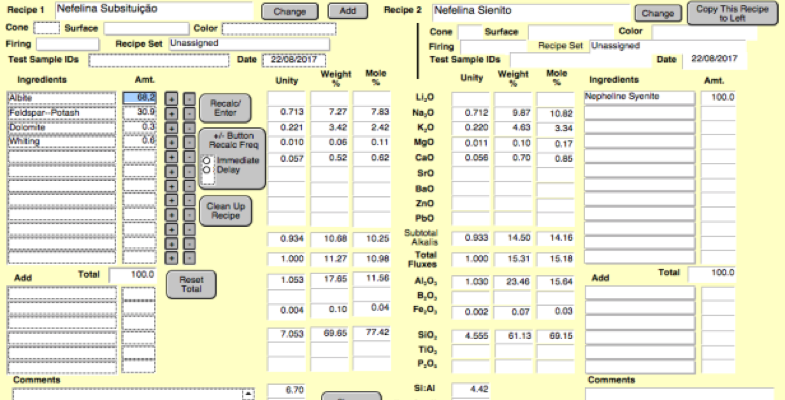
The result is shown above. Notice how similar the proportions are in the flux rows, labelled Alkalis. The problem is that the substitute contains too much silica (SiO2) and alumina (Al2O3). I address this by reducing any silica in the glaze recipe. Reducing the kaolin or ball-clay content should help lower the alumina content.
Conclusion
Although it is difficult to be certain of raw-material chemistry, I believe glaze-calculation software allows us to substitute ingredients with a more scientific approach to testing. The approach is purely theoretical, but it may help produce studio results similar to those obtained where the recipes originated.
Imagine how difficult it would be to buy Fukushima feldspar, a principal ingredient in Kinuta celadon, here in Brazil. Knowing its chemical formula, which is available from many online sources, allows us to substitute it. Generally speaking, in the heat of the kiln it makes no difference which mineral supplied an oxide: everything will be mixed together!
Some other suggested substitutions using glaze-formulation software:
- Wollastonite with Calcium Carbonate
- Lithium Carbonate with Spodumene
- Bone Ash with Tricalcium Phosphate… etc.
Until the next post! ;-)
About the Author: Gustavo Assis

Related Posts

Boa noite Gustavo!
Tudo bem?
Muito boas suas matérias, muito obrigada por compartilhar seus conhecimentos.
Gostaria de saber como eu adquiro o programa GlazeMaster.
Obrigada pela atenção.
Obrigado pela leitura! O programa Glaze Master pode ser baixado pelo site http://www.masteringglazes.com
Oi Gustavo, adorei tudo que compartilhou…toda sua experiência… obrigada…
Que bom que gostou. Muito obrigado!
Gostei do seu estudo.
Thank you for reading!