
Flocculated and Deflocculated Glazes
Hello everyone! This post will be a little more technical, but I hope it will help potters experiencing problems with glaze application.
Introduction
Sometimes a glaze seems very thick; at other times, it appears too thin. Our instinct is to add water in the first case or remove it in the second, but this can cause a range of problems.
Glazing involves many uncertainties, so the more measurements we can use to maintain control, the better. One way to obtain consistent results is to maintain the same density while changing the glaze’s viscosity without adding or removing water. Hydrometers are available for measuring density, but there is a very simple alternative: weigh 100 ml of glaze. If the scale reads 140 g, for example, its density is 1.40.
Depending on their composition, glazes can generally be acidic or basic. The pH of the suspension affects how the negative charges in the glaze orient the clay particles, making it flocculated (thick) or deflocculated (thin).
Let us look more closely at each state:
Flocculated Glaze
A condition in which oppositely charged particles attract each other, forming small flocs. These remain suspended for a long time and settle slowly in a loose pattern.
For dipping, the ideal glaze tends towards flocculation. The network of particles suspended in water adheres better to the piece, producing a more even coating. For brushing, however, a deflocculated glaze is preferable.
Even for dipping, care is needed to avoid excessive flocculation, which gives a false impression of high density.
A glaze that dries slowly after application and appears excessively thick shows signs of flocculation. Glazes with a high clay and/or sodium content may behave this way.
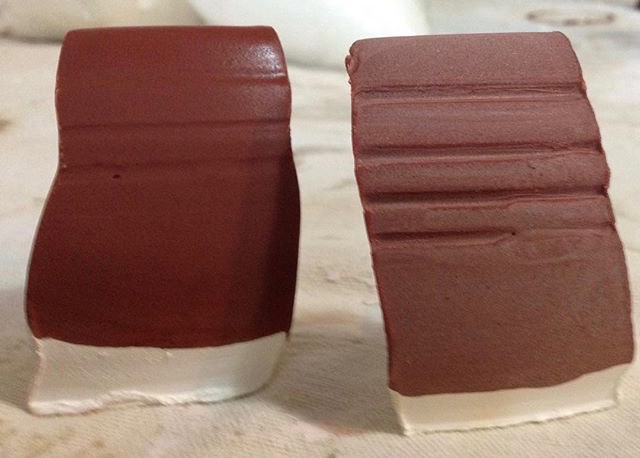
The same glaze, flocculated on the left and deflocculated on the right
To deflocculate a glaze, add a little sodium silicate—a very small amount. As if by magic, a thick glaze becomes as fluid as water!
Deflocculated Glaze
A deflocculated glaze has little clay and/or an alkaline pH. Glazes with high proportions of frit, soda feldspar (albite) or nepheline syenite are more likely to be deflocculated.
These glazes can be troublesome, especially when applied by dipping. They run excessively, giving an uneven coating. They drip heavily, and the drops dry quickly, leaving marks on the piece.
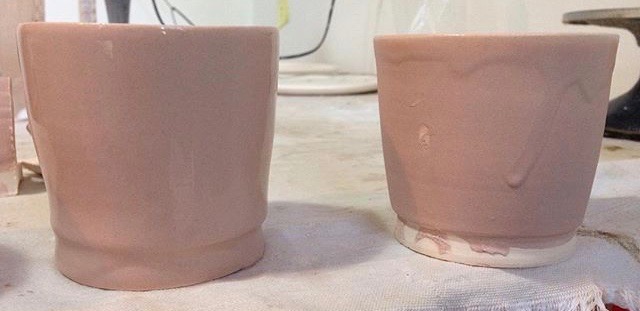
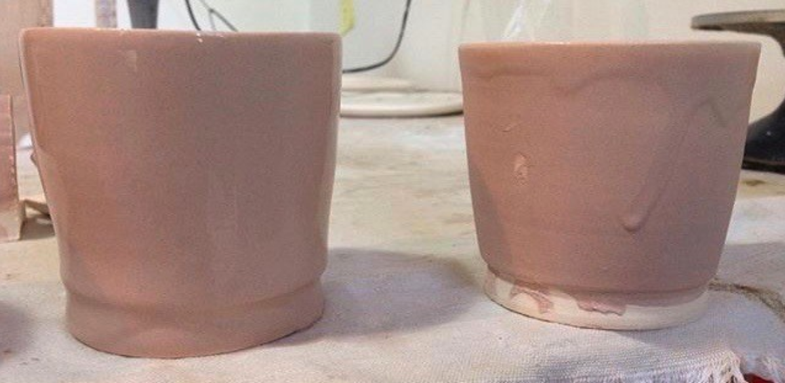
The same glaze, flocculated on the left and deflocculated on the right
How can this be addressed? The potter should follow these steps:
- Add 2–4% bentonite; if this does not resolve the problem:
- Add 1% Epsom salt (magnesium sulphate); if this does not resolve the problem:
- Add CMC (carboxymethylcellulose)
Conclusion:
A good glaze recipe does not guarantee success. Potters must pay attention to viscosity. Keeping density constant—that is, without changing the water content—we can significantly alter viscosity and make a substantial difference to the finished piece.
Over time, even after its viscosity has been properly adjusted using these methods, a glaze may return to its original flocculated or deflocculated state. It is therefore worth checking and correcting it whenever necessary.
Source:
- http://www.claytimes.com/articles/glazeadjusting.html
About the Author: Gustavo Assis

Related Posts


Excelente artigo. Esclarecedor.
Olá Roka, obrigado pela leitura!
Muito bom artigo! Escreva sempre e vamos partilhar nossas experiências. O q v acha da adição de vinagre?
Cristina, obrigado pela leitura! Seria ótimo partilhar experiências! Eu já usei vinagre para flocular (engrossar) esmaltes e engobes mas acho o sal de epsom mais eficaz.
Muy valiosa tu explicación!
Gracias Rose! Saludos!
Muito legal e generoso da sua parte! Esmaltes são apaixonantes e complicados…
Thank you for reading!