
Celadon glaze in Japan
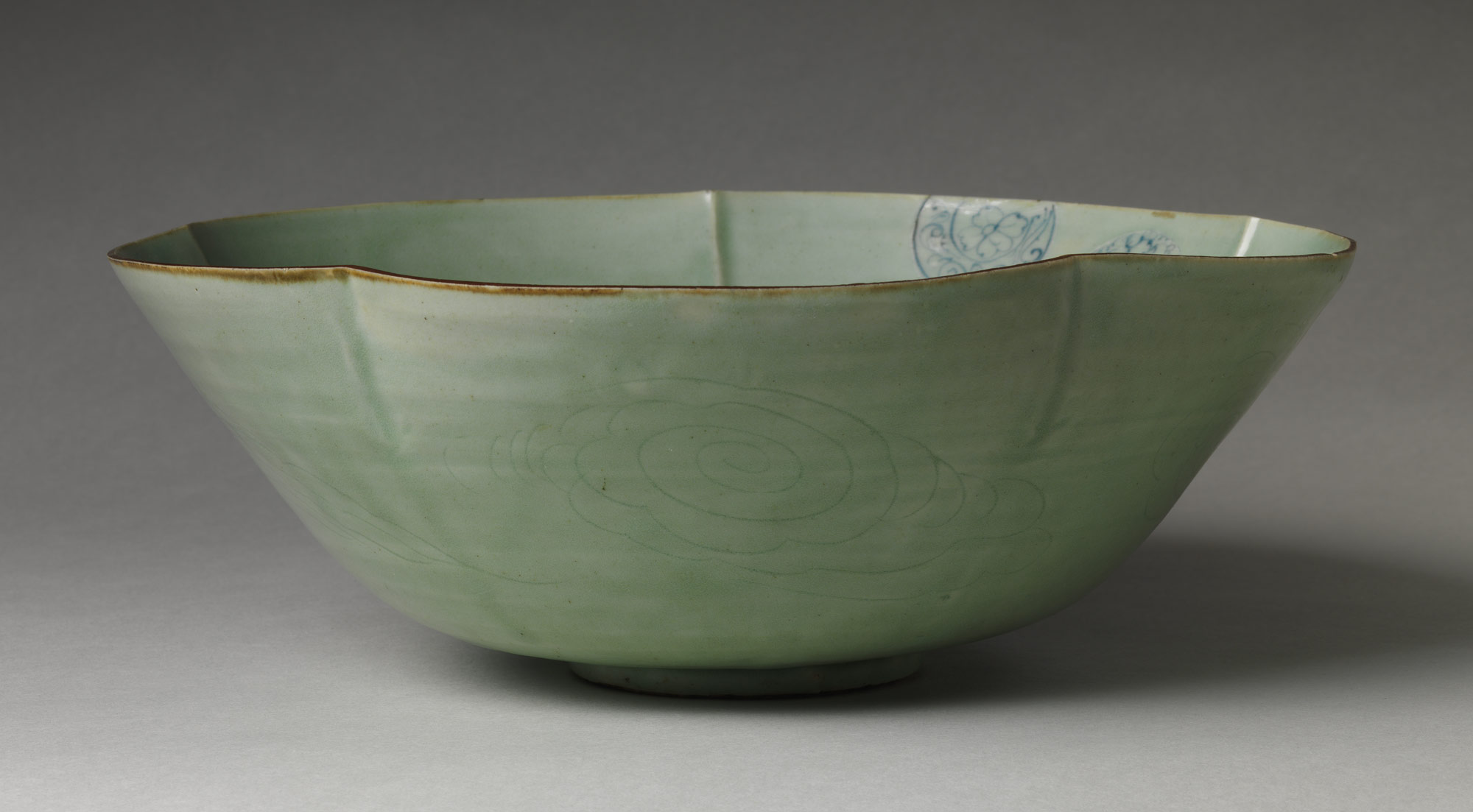
In the previous post, I discussed the history of celadon. Today we will look at the techniques behind this glaze in Japan.
Celadon glaze in Japan
Celadon glaze develops blue to green colours during the final reduction firing, in a low-oxygen atmosphere. This colouring also depends on the inclusion of a very small amount of iron in the glaze.
-
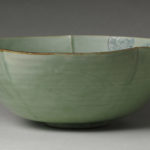
- Large bowl with floral decoration. Edo period (1615–1868), Japan. Metropolitan Museum, New York.
-
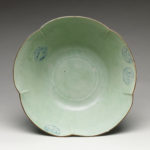
- Large bowl with floral decoration. Edo period (1615–1868), Japan. Metropolitan Museum, New York.
With a small proportion of iron, the piece takes on a pale colour resembling greenish-white porcelain. With almost no iron, the glaze becomes transparent, as in white porcelain and blue-and-white ware (some-tsuke).
Yellow celadon
If the final firing is strongly oxidising rather than reducing, the colour tends towards yellow. If the glaze is not very thick, it resembles Kizeto or Ofuke ware. This is because celadon, Kizeto and Sōmokubai, literally “grass and tree ash”, all use ash glaze (kaiyū) as their base.
-
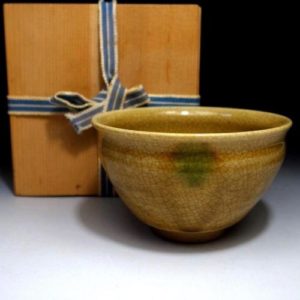
- Kizeto ware
-
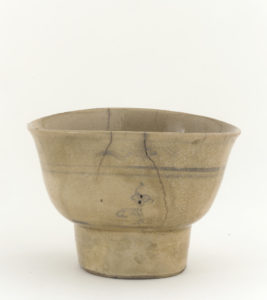
- Ofuke ware. Smithsonian Museum.
Ofukeiyū glaze, also called “Mino celadon”, can be considered a relative of celadon glaze. Its colour develops in the same way as celadon during the final firing.
Although we have described yellowish pieces, when we speak of celadon we usually mean bluish wares. This association may exist because the Japanese word itself contains the character for “blue”.
Since ancient times, this glaze has been composed of feldspar and ash. Although it was called “green porcelain”, there was certainly an awareness that this ash glaze contained small amounts of iron particles.
Sōmokubai contains impurities such as phosphoric acid, which give its colour a certain warmth. On the one hand, the colouring is inconsistent; on the other, the individuality of Sōmokubai's uneven colour is thought to be part of its appeal.
Celadon recipes
Composition example 1 – Fukushima feldspar 6: ash of isu (a plant of the genus Distylum) 4. Remaining proportion: iron(III) oxide (red ochre pigment, or bengala): 1 to 2%.
Composition example 2: Fukushima feldspar 6: Tsuchibai 4 (mixed wood ash).
Composition 1 uses a considerable amount of iron because isu ash contains little of it. Depending on the ash, however, iron may also be abundant.
For example, mixed wood ash, Tsuchibai, may contain more than 3% iron. This is excessive for celadon, which requires only 1 to 2% iron. Ash from branches containing almost no iron has a composition resembling limestone.
Composition example 3: Fukushima feldspar 5: limestone 1: Korean kaolin 1: silica stone 3. Remaining proportion: iron(III) oxide (red ochre pigment, or bengala): 1 to 2%.
Composition example 4: Fukushima feldspar 5: limestone 1: strontium carbonate 1: silica stone 3. Remaining proportion: iron(III) oxide (red ochre pigment, or bengala): 1 to 2%.
This is a mixture of transparent some-tsuke glaze with added bengala (iron(III) oxide). Strontium carbonate increases the air bubbles and can be replaced with barium oxide.
Although limestone mixtures contain few impurities and produce uniform colouring, they can also lack vitality.
With iron-rich clays, it may not be necessary to add oxides such as bengala to achieve a pale celadon colour. In this case, the clay rather than the glaze changes the parameters of the colouring.
The key elements of this glaze are therefore a small amount of iron in the glaze or clay and a final reduction firing. But glaze thickness is also essential.
Applying celadon: a thick glaze
A thick glaze application creates a thick glassy layer. Air bubbles are contained within this layer, so increasing its thickness also increases the number of bubbles. The resulting diffuse reflection of light produces a complex colour.
Viewed under magnification, the bubbles form multiple layers. In the light, areas containing bubbles appear lighter, while areas without bubbles look slightly darker. Each area has its own colour, producing a complex mixture of tones.
If there are few air bubbles and the glaze is thin, the colour lacks vitality and depth. It also becomes pale, weakening the richness of the blue-green.
To enrich the colour, we should not simply increase the proportion of iron. More iron alone makes the piece darker, eventually producing a glaze of the Ameyū or Kuroyū type, Japanese brown and black glazes respectively. Applying a thick glaze instead increases the depth of the celadon and creates a rich blue-green colour.
When applying 2 to 3 glaze layers, we also mix in an adhesive paste made from seaweed called Funori to improve the glaze's adhesion to the clay.
A thick glaze layer is consequently more prone to crazing: cracks in the glaze surface that inevitably occur across the piece when it is removed from the kiln. Even pieces where these are difficult to see will, strictly speaking, have fine crazing.
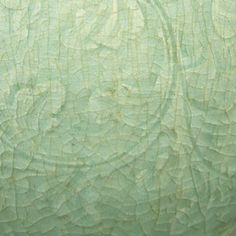
As the piece ages, dirt can become visible in the crazing. The cracks were present initially, but repeated use makes them more apparent.
With continued use, water or moisture may also penetrate through the crazing and cause expansion cracks. This rare occurrence is called hygroscopic expansion. With ceramics, the possibility is never zero.
Celadon thus reveals its character through both early and later crazing. It is a glaze with simple origins in grass and tree ash, sōmokubai, yet its variable colours and long history give it depth in many senses.
Sources:
- Asia Society, 2007. Korean Ceramics – http://www.asiasocietymuseum.org/region_results.asp?RegionID=5&CountryID=13&ChapterID=35
- China Virtual Tours, 2014. A Brief History of Ceramics – http://www.chinavista.com/experience/ceramics/ceramics.html
- Lee, S., 2003. Goryeo Celadon – https://www.metmuseum.org/toah/hd/cela/hd_cela.htm
- Nanhai Marine Archeology Sdn. Bhd., 2016. Pottery – http://www.mingwrecks.com/pottery.html
- Welcome to Chiangmai and Chiangrai magazine, 2014. The Making of Celadon – http://www.chiangmai-chiangrai.com/making_of_celadon.html
- www.korean-arts.com, 2016. The Age of Celadon – http://www.korean-arts.com/about/age_of_celadon.htm
- www.visual-arts-cork.com, 2016. Chinese Pottery (18,000 BCE – 1911 CE) – http://www.visual-arts-cork.com/east-asian-art/chinese-pottery.htm
- Tōjiki, o yakutachi jōhō. Seijiyū. http://touroji.com/yuuyakunosyurui/seijiyuu
- Mingren, Wu. Celadon appreciating pottery its aesthetic value and magical qualities. http://www.ancient-origins.net/artifacts-other-artifacts/celadon-appreciating-pottery-its-aesthetic-value-and-magical-qualities?page=0%2C1
About the Author: Gustavo Assis

Related Posts

[…] Celadon (learn more about celadon here) […]
A very interesting website.
Thank you very much for reading!
Thank you for sharing! Really interesting!
Thank you for reading!